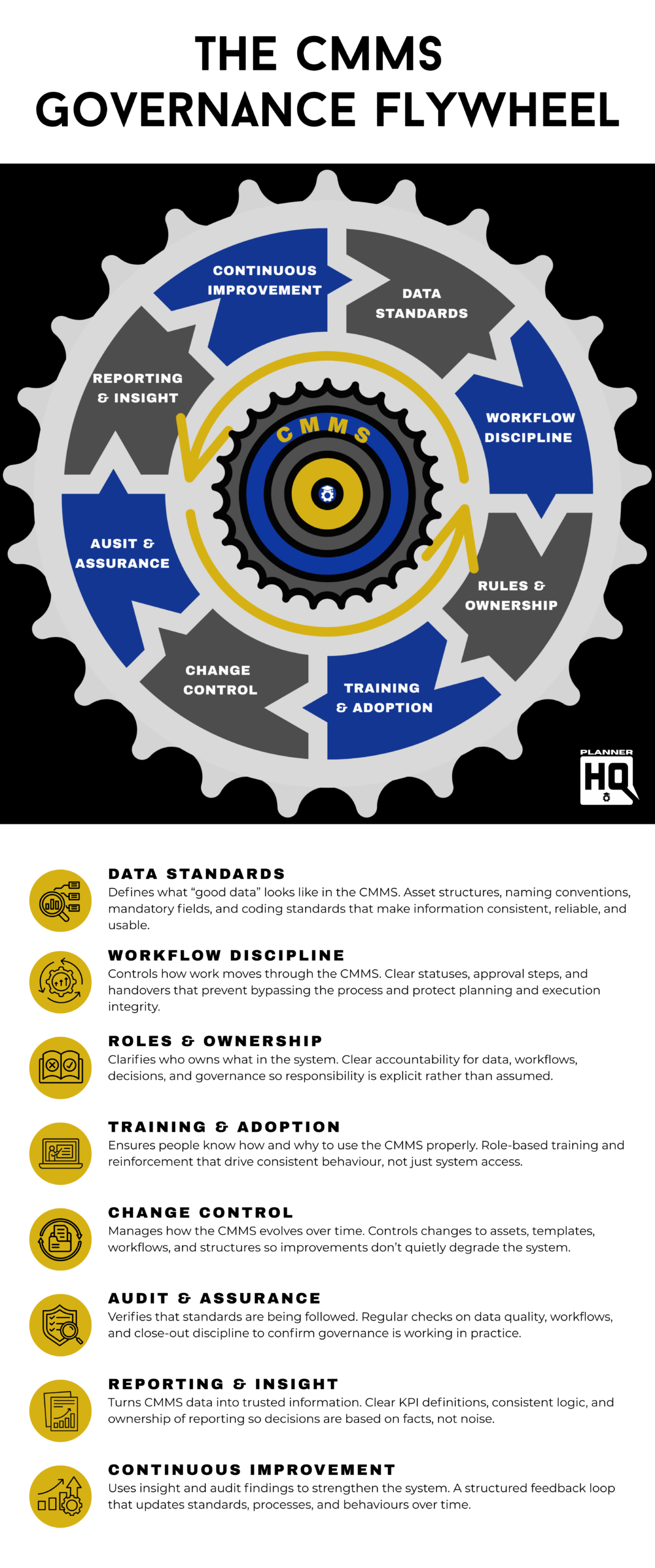
The CMMS Governance Flywheel
The CMMS Governance Flywheel is a systems model that explains why some CMMS environments remain reliable and trusted over time, while others slowly degrade despite having capable software and experienced people.
Rather than treating CMMS performance as a setup or configuration issue, the flywheel frames it as a governance challenge. It shows that long-term CMMS success depends on a set of reinforcing controls that must be designed, owned, maintained, and continuously improved. When these controls work together, the system remains stable and effective. When one or more are weak, performance decays.
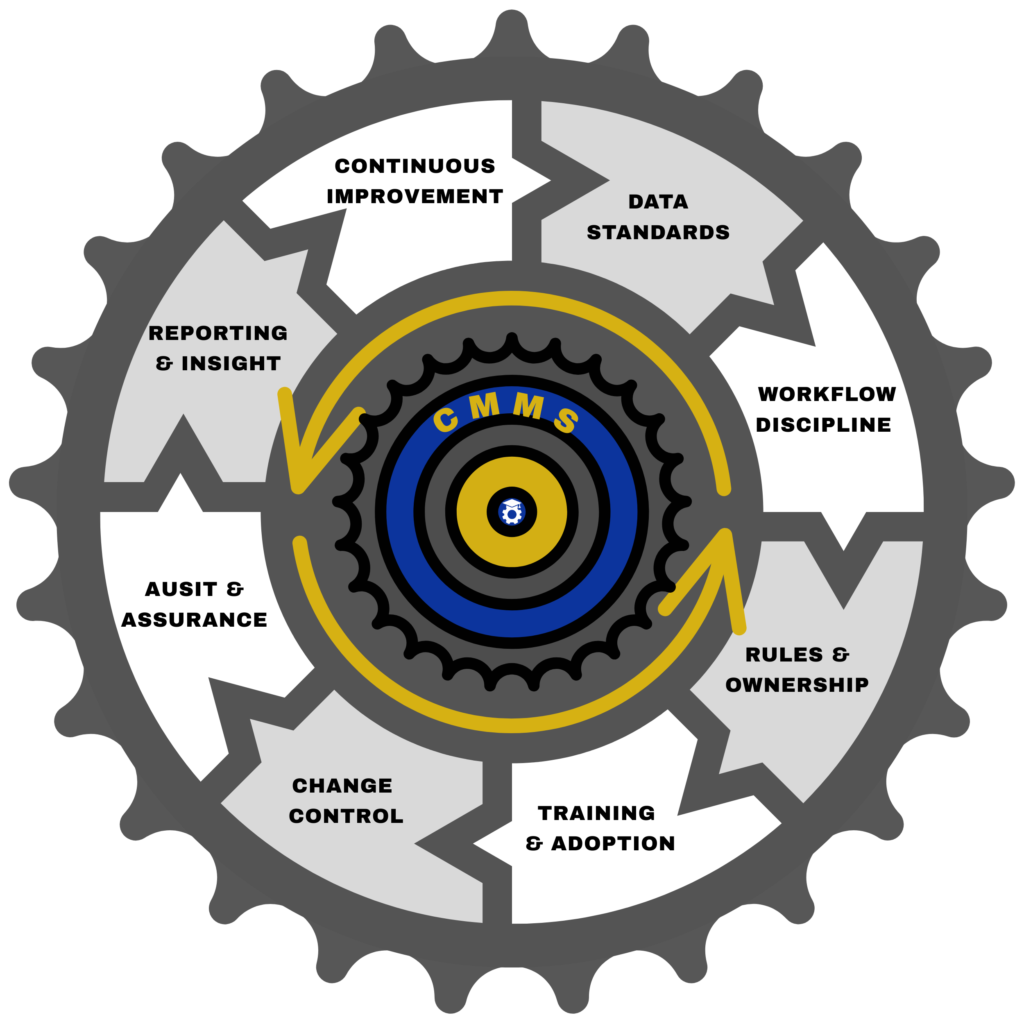
The model is intentionally circular. CMMS governance is not a linear journey with an end point. It is an ongoing cycle where standards are defined, applied, checked, and refined. Each segment of the flywheel represents a different governance mechanism that keeps the system aligned with how the organisation actually works.
At the centre of the flywheel sits the CMMS itself. The system is not the solution on its own. It is the hub around which governance operates. Without effective governance, even the best CMMS implementations become inconsistent, mistrusted, and under-used over time.
Why CMMS Governance Matters
Many organisations experience the same pattern with their CMMS. Initial implementations are well intentioned, but over time data quality slips, workflows are bypassed, reporting loses credibility, and the system becomes something people work around rather than rely on.
This does not usually happen because of poor software or lack of effort. It happens because governance mechanisms are incomplete, unclear, or unenforced.
The CMMS Governance Flywheel makes this visible. It highlights that issues such as poor data, inconsistent workflows, unreliable KPIs, or low user adoption are rarely isolated problems. They are symptoms of gaps elsewhere in the system. Without standards, ownership, training, assurance, and structured improvement, problems reappear even after they are “fixed”.
Strong governance does not make a CMMS bureaucratic. It makes it predictable. It allows planners, supervisors, engineers, and managers to trust the system, use its outputs with confidence, and build improvement on a stable foundation.
How the Flywheel Works
Each segment of the CMMS Governance Flywheel represents a different but interdependent control. No single segment is sufficient on its own. Weakness in one area places strain on the others, eventually slowing or destabilising the entire system.
Data standards define what good information looks like. Workflow discipline ensures work moves through the system as intended. Roles and ownership make accountability explicit. Training and adoption drive consistent behaviour. Change control prevents uncontrolled degradation. Audit and assurance confirm standards are being followed. Reporting and insight turn data into decisions. Continuous improvement closes the loop and strengthens the system over time.
Because the flywheel is continuous, governance is never “finished”. The goal is not perfection, but stability and control. Organisations with effective CMMS governance are able to absorb change, onboard new people, introduce new assets, and evolve their maintenance strategies without losing trust in the system.
The CMMS Governance Flywheel provides a clear, structured way to understand where governance is strong, where it is weak, and where effort should be focused to restore balance.
The Eight Governance Segments Explained
The CMMS Governance Flywheel is made up of eight interdependent governance segments. Each one controls a different aspect of how the CMMS operates, evolves, and delivers value over time.
Individually, each segment addresses a specific failure mode. Together, they form a reinforcing system that keeps the CMMS reliable, trusted, and fit for purpose as the organisation changes.
1. Data Standards
Data standards are the foundation of the CMMS Governance Flywheel because every workflow, report, and decision downstream depends on the quality and consistency of the information going into the system. A CMMS does not fail gracefully when data standards are weak. It becomes noisy, mistrusted, and eventually ignored, because people stop believing what it tells them.
In practical terms, data standards define what “good” looks like. They remove ambiguity by making sure two people doing the same task would enter the same information in the same way. Without standards, the CMMS becomes a collection of personal preferences: different naming conventions, inconsistent classifications, incomplete close-outs, and work history that cannot be analysed. The system may still function, but it will not scale, and it will not support learning.
Strong CMMS governance treats data as an operational asset, not an admin by-product. That means standardising the structures that enable maintenance work to be planned, scheduled, executed, and analysed reliably over time. It also means accepting that data standards are never “done”. As new equipment is added, priorities shift, or reporting needs evolve, standards must be maintained and reinforced, otherwise drift sets in.
Data standards are also where a lot of organisations unintentionally sabotage themselves. They may invest heavily in the CMMS, mobile devices, dashboards, and reporting tools, but if the underlying data is inconsistent, those investments simply amplify confusion. The CMMS ends up producing reports that look professional but are operationally misleading, which is often worse than having no report at all.
The goal of this segment is not to make the CMMS perfect. It is to make the CMMS consistent. Consistency is what enables trust, and trust is what enables adoption and improvement.
Summary of what “Data Standards” typically covers:
- Close-out data standards (what must be captured for history to be useful)
- Asset hierarchy rules (how equipment is structured and parent-child relationships are defined)
- Naming conventions and ID formats for assets, locations, and functional positions
- Mandatory fields and minimum data requirements at key points in the workflow
- Work order categorisation standards (type, priority, craft/trade, work class)
- Failure coding and cause codes (definitions, usage rules, and when they are required)
- Job plan and PM template standards (format, task structure, estimated durations, safety steps)
- Materials and spare parts data rules (catalogue standards, units of measure, criticality fields)
- Close-out data standards (what must be captured for history to be useful)
2. Workflow Discipline
Workflow discipline governs how work moves through the CMMS from request to close-out. It defines the permitted paths, the decision points, and the handovers that protect planning and execution from becoming reactive and inconsistent.
Without discipline, workflows quickly erode. Statuses are skipped, approvals are bypassed, and work orders jump straight to execution without proper planning or coordination. Over time, this creates a system where the CMMS no longer reflects reality. People stop trusting statuses, planners lose control of the schedule, and reporting becomes unreliable because the underlying process is no longer being followed.
Strong workflow discipline does not exist to add bureaucracy. It exists to create predictability. Clear workflow rules ensure that work is reviewed at the right time, planned to the right standard, and released in a controlled way. This allows planners to protect readiness, manage constraints, and maintain a stable schedule rather than constantly reacting to last-minute changes.
Workflow discipline is also one of the hardest governance elements to sustain. It requires consistent enforcement, clear ownership, and support from leadership when shortcuts are challenged. When discipline weakens, the impact is immediate: planning quality drops, execution becomes chaotic, and the CMMS is reduced to a passive record-keeping tool rather than an active control system.
The objective of this segment is not rigid compliance for its own sake. It is to ensure that the CMMS workflow reflects how the organisation intends work to be planned, scheduled, and executed, and that deviations are deliberate rather than accidental.
Summary of what “Workflow Discipline” typically covers:
- Alignment between CMMS workflow and real-world execution practices
- Defined workflow stages from request through to close-out
- Clear status definitions and entry/exit criteria
- Approval points for scope, priority, and release to schedule
- Rules for bypassing or expediting work, including who can authorise exceptions
- Separation of planning, scheduling, and execution states
- Controls to prevent premature close-out or status manipulation
3. Roles & Ownership
Roles and ownership define who is responsible for what within the CMMS, and who has the authority to make decisions that affect data, workflows, and system behaviour. Without clear ownership, governance becomes ambiguous, and ambiguity is where standards quietly break down.
In many organisations, CMMS responsibilities are implied rather than defined. Planners, supervisors, engineers, and technicians all interact with the system, but accountability for data quality, workflow compliance, and structural integrity is often unclear. When issues arise, such as poor data, inconsistent practices, or conflicting reports, no single role owns the problem or the solution.
Strong governance makes ownership explicit. It clarifies who creates and approves work, who maintains master data, who owns templates and standards, and who is responsible for reviewing and improving how the system is used. This does not mean concentrating control in one role, but ensuring that decision rights are clearly understood and consistently applied.
Roles and ownership are also where leadership support becomes visible in practice. Governance only works when people with defined ownership are empowered to enforce standards, challenge non-compliance, and make changes without being undermined. When ownership exists without authority, governance becomes symbolic rather than effective.
The purpose of this segment is to remove uncertainty. When everyone knows their responsibilities and boundaries, the CMMS can operate as a controlled system rather than a shared spreadsheet with better graphics.
Summary of what “Roles & Ownership” typically covers:
- Alignment between CMMS roles and real organisational authority
- Clear ownership of work order creation, planning, scheduling, and close-out
- Accountability for master data (assets, locations, templates, failure codes)
- Defined approvers for changes to workflows, standards, and system structures
- Decision rights for prioritisation, overrides, and exceptions
- Ownership of reporting logic and KPI definitions
- Escalation paths when standards are not followed
4. Training & Adoption
Training and adoption ensure that the CMMS is used consistently and for the reasons it was designed. This segment focuses not just on teaching people how to navigate the system, but on reinforcing the behaviours that make governance effective over time.
Many CMMS environments fail not because people are unwilling, but because expectations are unclear. Users are given access with minimal guidance, training is limited to system mechanics, and little attention is paid to why specific standards or workflows exist. Over time, people develop their own shortcuts, workarounds, and interpretations, and governance slowly erodes.
Effective training is role-based and ongoing. Planners, technicians, supervisors, and managers all interact with the CMMS differently and require different levels of understanding. Training must align with governance expectations, showing not only what actions to take, but why they matter and how they affect downstream users and outcomes.
Adoption is reinforced through repetition, feedback, and visible consequences. When governance is working, good CMMS behaviour is recognised and poor behaviour is corrected. When it is not, users quickly learn that standards are optional. This segment bridges the gap between documented rules and actual day-to-day usage.
The goal of training and adoption is to make correct CMMS use the path of least resistance. When people understand both the how and the why, governance becomes part of normal work rather than an imposed burden.
Summary of what “Training & Adoption” typically covers:
- Reinforcement of expected behaviours through leadership and supervision
- Role-based CMMS training aligned to governance standards
- Onboarding processes for new starters and role changes
- Refresher training to prevent skill and behaviour drift
- Clear guidance on why standards and workflows exist
- Feedback loops to correct misuse or misunderstanding
- Support mechanisms for questions and edge cases
5. Change Control
Change control governs how the CMMS evolves over time without undermining the standards and discipline that keep it reliable. It recognises that change is inevitable, but unmanaged change is one of the fastest ways a CMMS degrades.
Every CMMS is subject to constant pressure for change. New assets are added, templates are adjusted, workflows are tweaked, priorities shift, and users request exceptions to existing rules. Without structured control, these changes accumulate informally. What begins as a small workaround quickly becomes embedded practice, and the original design intent of the system is lost.
Effective change control does not exist to slow improvement. It exists to ensure changes are deliberate, visible, and assessed for their wider impact. Changes to asset structures, job plans, PMs, workflows, and coding standards all have knock-on effects for reporting, planning quality, and execution. Change control provides a mechanism to evaluate those impacts before they reach the live system.
This segment is particularly important because CMMS degradation often happens quietly. The system still works, but trust erodes as inconsistencies appear. Strong change control prevents governance from being undone one small decision at a time.
The objective of this segment is to allow the CMMS to adapt while preserving integrity. A system that cannot change will become obsolete. A system that changes without control will become unreliable.
Summary of what “Change Control” typically covers:
- Periodic review of accumulated changes and their effectiveness
- Formal process for requesting and approving CMMS changes
- Defined ownership for reviewing and authorising changes
- Impact assessment for changes to data structures, workflows, and templates
- Version control for job plans, PMs, and standards
- Communication of approved changes to affected users
- Controlled implementation and rollback where required
6. Audit & Assurance
Audit and assurance confirm whether CMMS governance is actually working in practice, not just on paper. This segment provides the evidence loop that separates intended standards from real behaviour.
Most organisations have some form of CMMS standards, workflows, and training. What is often missing is a structured way to verify that those rules are being followed consistently and producing the intended outcomes. Without assurance, governance relies on assumption. Over time, small deviations go unnoticed, become normalised, and eventually undermine the system.
Effective audit is targeted and purposeful. It does not attempt to check everything at once or catch people out. Instead, it focuses on the areas where governance failure has the greatest impact: data quality, workflow compliance, close-out discipline, and the use of templates and codes. The aim is to identify patterns, not individual mistakes.
Assurance closes the loop between governance design and day-to-day execution. When audit findings are visible and acted upon, standards gain credibility. When issues are identified but ignored, users quickly learn that governance is optional. This segment therefore plays a critical role in maintaining trust in the CMMS as a control system.
The objective of audit and assurance is not perfection. It is early detection. By identifying drift early, organisations can correct issues before they become embedded and expensive to unwind.
Summary of what “Audit & Assurance” typically covers:
- Feedback of results into training and improvement activities
- Data quality audits on key CMMS fields and structures
- Workflow compliance checks against defined standards
- Review of work order close-out quality and completeness
- PM and job plan quality audits
- Trend analysis of recurring governance issues
- Clear ownership for acting on audit findings
7. Reporting & Insight
Reporting and insight turn CMMS data into information that people trust and use to make decisions. This segment sits at the point where governance becomes visible to management and operational leadership.
Many CMMS environments generate large volumes of reports but very little insight. Metrics are poorly defined, reports contradict one another, and users spend more time debating numbers than acting on them. This is rarely a reporting tool problem. It is a governance problem rooted in inconsistent data, unclear definitions, and lack of ownership.
Strong governance ensures that KPIs have clear logic, consistent definitions, and a defined purpose. Reports exist to support decisions, not to satisfy curiosity or populate dashboards. When reporting is aligned to governance standards, the CMMS becomes a reliable source of truth rather than a contested data set.
Ownership is critical at this layer. Every report and metric should have a clear owner who understands how the data is generated, what assumptions are built in, and how the output should be interpreted. Without this, reporting quickly becomes detached from reality and loses credibility with decision-makers.
The objective of reporting and insight is not volume. It is clarity. Well-governed reporting highlights trends, exceptions, and risks that matter, allowing organisations to act with confidence rather than react to noise.
Summary of what “Reporting & Insight” typically covers:
- Regular review of reporting relevance and effectiveness
- Clear definitions and logic for CMMS KPIs and metrics
- Alignment between data standards, workflows, and reporting outputs
- Ownership of reports and dashboards
- Consistent calculation methods across teams and sites
- Validation of reports against operational reality
- Use of reports to drive decisions, not just visibility
8. Continuous Improvement
Continuous improvement ensures that CMMS governance does not stagnate. It closes the loop by using insight, audit findings, and operational feedback to strengthen the system over time rather than simply maintain it.
Without a structured improvement mechanism, governance becomes static. Standards are set, workflows are defined, and training is delivered, but the system fails to adapt as the organisation changes. New assets, new ways of working, and new performance expectations slowly outgrow the original design, and governance becomes misaligned with reality.
Effective continuous improvement is deliberate and prioritised. It focuses on addressing systemic issues rather than reacting to individual incidents. Trends identified through reporting, assurance activities, and user feedback are reviewed, root causes are understood, and changes are made through controlled mechanisms rather than informal workarounds.
This segment also prevents governance fatigue. When users see that issues raised through audits or feedback lead to tangible improvements, engagement increases. When problems persist without action, governance is quickly perceived as performative rather than valuable.
The objective of continuous improvement is to keep the CMMS relevant, trusted, and aligned with how maintenance actually operates. It ensures that governance evolves in step with the organisation rather than becoming a constraint on progress.
Summary of what “Continuous Improvement” typically covers:
- Reinforcement of governance as a living system
- Review of audit findings and performance trends
- Identification and prioritisation of governance improvement actions
- Structured improvement backlog for CMMS governance
- Root cause analysis of recurring system issues
- Updates to standards, workflows, and training based on learning
- Measurement of improvement effectiveness over time
How to Use the CMMS Governance Flywheel
The CMMS Governance Flywheel is designed to be used as a diagnostic and alignment tool, not as a compliance checklist or one-time assessment. Its value lies in helping individuals and organisations understand where governance is strong, where it is weak, and why the system behaves the way it does.
At an individual or team level, the flywheel can be used to reflect on current CMMS performance. Rather than asking whether the system is “good” or “bad”, it encourages more useful questions: which governance segments are supporting the system, and which are quietly undermining it? Many common frustrations with CMMS usage can be traced back to one or two weak segments rather than a failure of the system as a whole.
For managers and leaders, the flywheel provides a shared language to discuss CMMS health without defaulting to software changes or new tools. It makes it easier to see whether issues are caused by missing standards, unclear ownership, poor adoption, weak assurance, or lack of structured improvement. This helps focus effort on governance design rather than repeated tactical fixes.
The framework can also be used to guide prioritisation. Strengthening every segment at once is rarely practical. The flywheel helps identify where targeted improvements will have the greatest stabilising effect on the system. In many cases, improving one or two key segments will unlock progress elsewhere.
Most importantly, the CMMS Governance Flywheel should be revisited regularly. Governance is not static. As organisations grow, restructure, or change strategy, governance controls must evolve with them. Used consistently, the flywheel becomes a reference point for maintaining CMMS integrity over time rather than reacting to its decline.
What Comes Next
The CMMS Governance Flywheel is intended as a starting point, not an end state. Its purpose is to help planners, CMMS specialists, and maintenance leaders clearly understand where governance is strong, where it is weak, and why their system behaves the way it does.
Over time, this framework will be supported by practical tools that allow the model to be applied more directly. This will include self-assessment mechanisms to help teams evaluate governance maturity across the eight segments and focus improvement effort where it will have the greatest impact.
The flywheel also forms part of a wider Planner HQ system. It underpins how CMMS environments are designed, governed, and improved, and connects directly to deeper guidance on planning effectiveness, data quality, workflows, and performance management.
For now, the CMMS Governance Flywheel provides a clear reference point. It offers a structured way to think about CMMS health beyond software features, and a foundation for more deliberate, sustainable improvement.
Stay Connected to the Planner HQ Learning Journey
Occasional updates when new frameworks, resources, and planning insights are released.