The Planners Value Stack
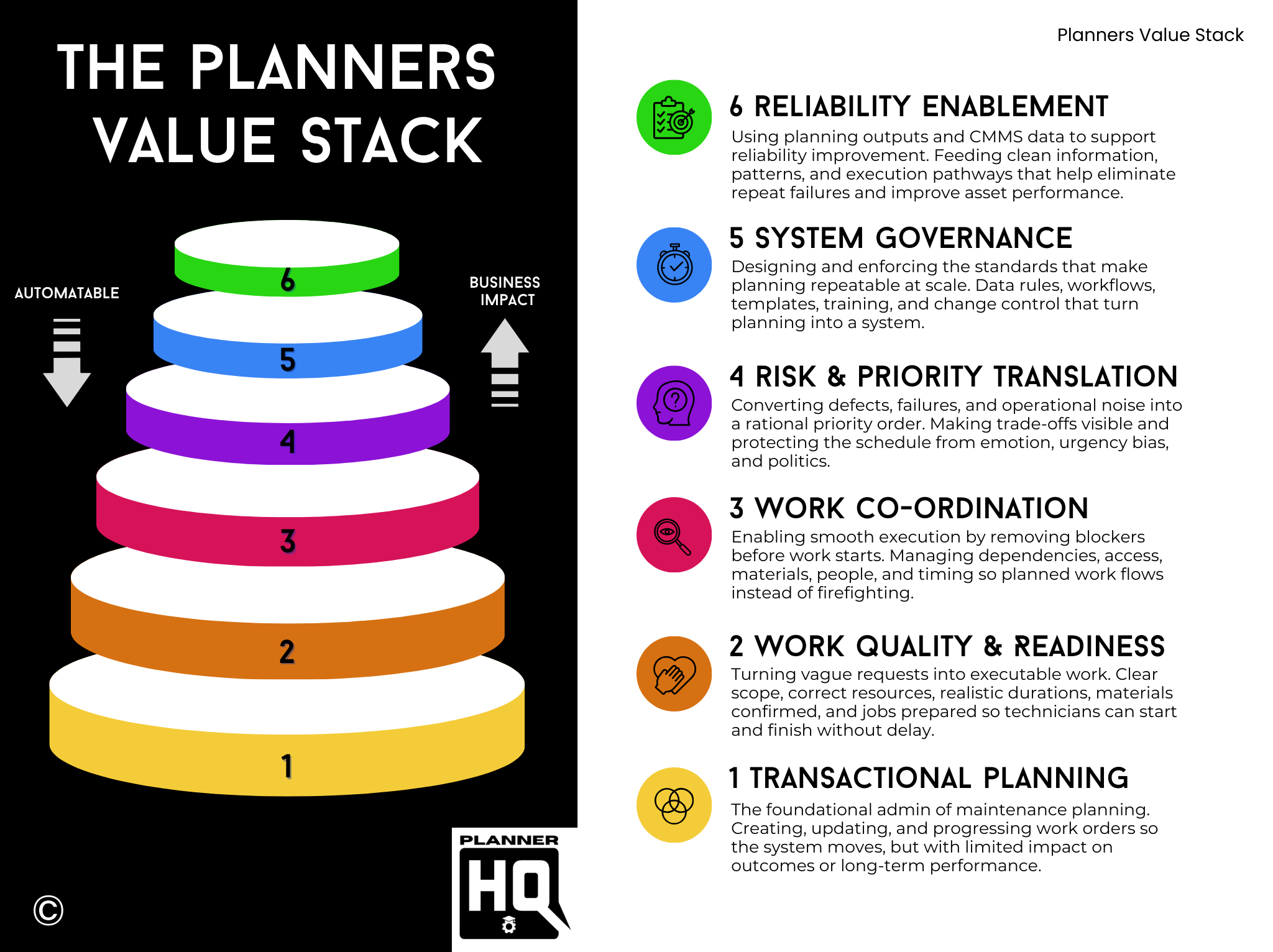
The Planners Value Stack model shows how maintenance planning value is built in layers, from automatable admin at the bottom to high-impact reliability enablement at the top
The Planner Value Stack is a practical model that explains where maintenance planners create value, and why the role looks very different depending on how it is applied.
It shows how planning evolves from basic transactional work into coordination, decision support, governance, and ultimately reliability enablement.
The Planner Value Stack is a layered model that explains where maintenance planners create value, and why the role can look very different from one organisation to another.
Rather than treating planning as a single skill or job description, the stack shows that planning value is built in layers. Each layer represents a different type of contribution, from keeping work moving at the most basic level through to shaping reliability outcomes at the highest level.
All six layers matter. The lower layers provide the foundation that allows maintenance work to function at all. The higher layers build on that foundation to improve flow, decision-making, governance, and long-term performance. One layer does not replace another; each depends on the ones below it.
The model is not a maturity scorecard and it is not a hierarchy of job titles. A planner does not “graduate” from one layer to the next and abandon earlier responsibilities. In reality, most planners operate across multiple layers at the same time, depending on how their role is designed and supported.
What the Planner Value Stack does is make planning value visible. It provides a shared language to explain why some planning roles feel administrative and reactive, while others are trusted, influential, and closely tied to business outcomes.
This model does not describe job titles or seniority. It describes where planning effort is focused.
How the Planner Value Stack Works
The Planner Value Stack works by showing how different types of planning activity sit on top of one another, with each layer increasing the planner’s influence on outcomes rather than simply increasing workload.
At the lower layers, planning effort is focused on execution. The goal is to keep work orders moving, ensure jobs are prepared correctly, and support the day-to-day flow of maintenance. This work is essential, but its impact is often limited to individual jobs or short time horizons.
As planning effort moves up the stack, the focus shifts from individual tasks to systems and decisions. Planners begin to shape how work flows through the organisation, how priorities are set, how standards are applied, and how information is fed into reliability improvement. The impact becomes broader, longer-term, and more visible to management.
Importantly, progression up the stack does not mean abandoning lower-layer responsibilities. Strong planning roles are built by maintaining solid foundations while adding higher-leverage work on top. When the lower layers are weak or under-resourced, planners are often prevented from operating higher up the stack, regardless of their capability.
The stack also helps explain why planning roles vary so widely between organisations. Two planners with the same job title may sit at very different points in the stack depending on expectations, systems, governance, and organisational maturity.
By making these layers explicit, the Planner Value Stack allows individuals and organisations to see where planning effort is currently concentrated, and where the greatest opportunities for improvement and impact lie.
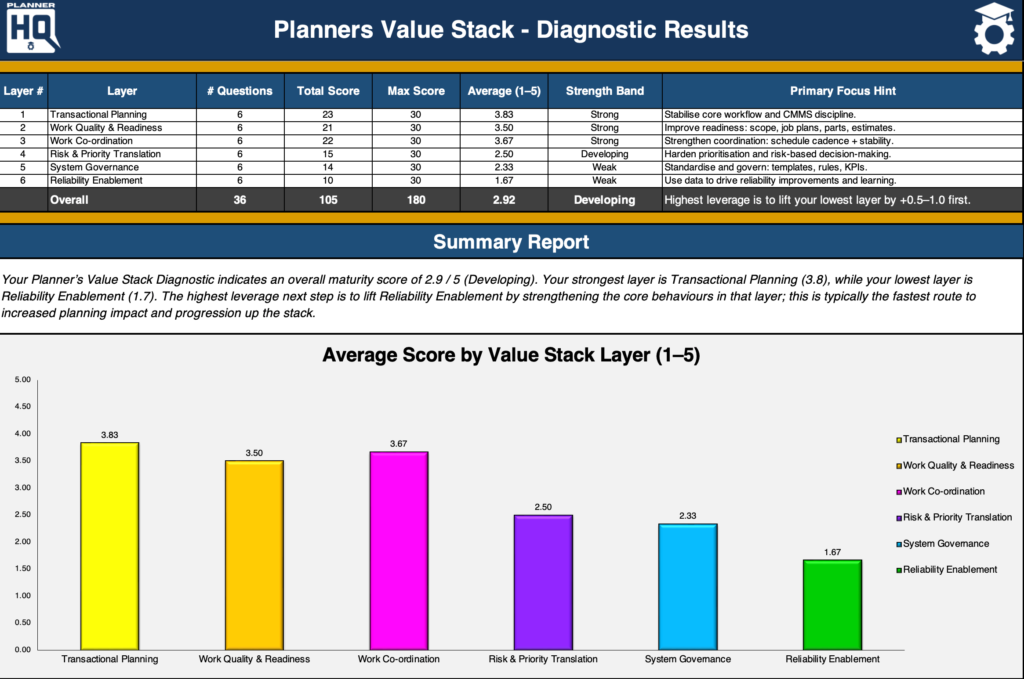
Not Sure where you sit on the value stack?
Take the Planner HQ Value Stack Self Assessment
Identify your current maturity level and uncover your next highest-impact improvement area.
The Two Forces Shaping Planning Value
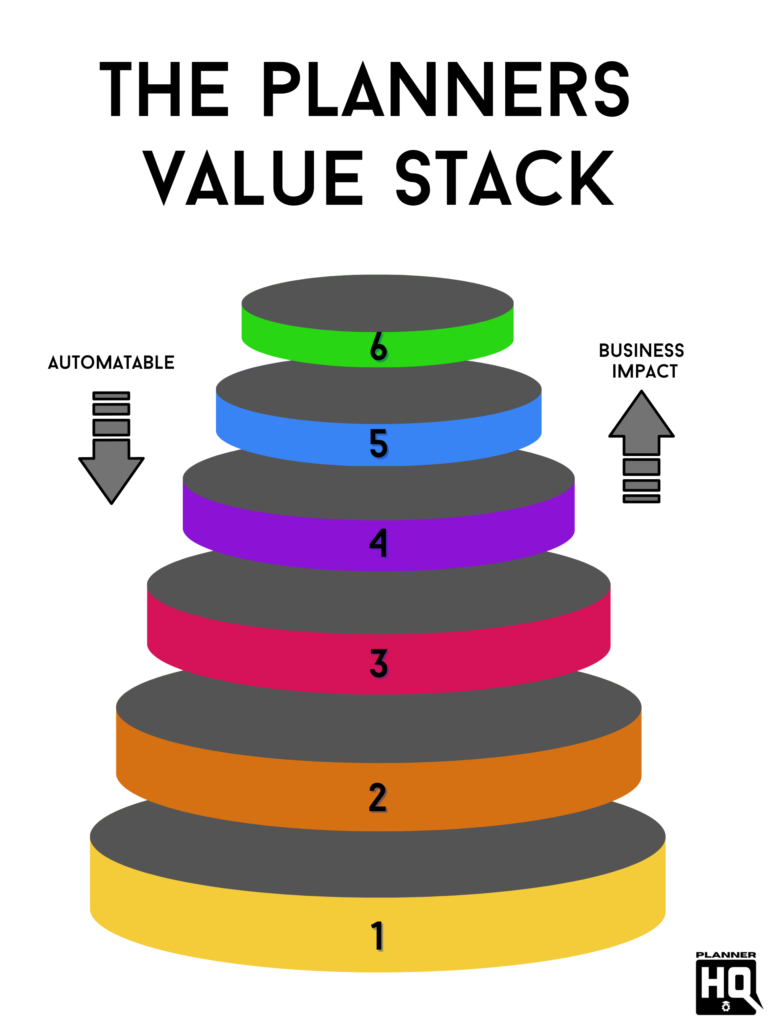
The Planner Value Stack is shaped by two opposing forces that influence how planning work is perceived, valued, and invested in: Automatable and Business Impact. These forces help explain why some planning activities are easily replaced or overlooked, while others are critical to performance and decision-making.
Automatable
The left-hand arrow represents how easily different types of planning work can be standardised, automated, or system-supported.
As you move down the stack, planning activities become more repetitive, rules-based, and predictable. Tasks such as work order creation, basic updates, routing, and administrative hygiene follow defined processes and rely heavily on system rules. As CMMS platforms improve and automation increases, this type of work becomes easier to streamline or reduce.
This does not mean these activities are unimportant. They form the foundation of the maintenance system. However, because they are easier to standardise and automate, they are also more likely to be undervalued or seen as commodity work when viewed in isolation.
Business Impact
The right-hand arrow represents the degree to which planning work influences outcomes rather than just activity.
As you move up the stack, planning effort shifts toward coordination, judgement, governance, and enablement. These activities shape how work flows, how risk is managed, how priorities are set, and how reliability improvements are executed. They are harder to automate because they rely on context, trade-offs, and cross-functional understanding.
Higher layers of the stack have greater business impact because they affect multiple jobs, multiple teams, and longer time horizons. They influence not just whether work gets done, but how effectively the organisation performs over time.
Together, these two forces explain a key insight of the Planner Value Stack: planning becomes harder to replace and more valuable as it moves away from repetitive execution and toward system design, decision support, and reliability enablement.
The Layers of the Planners Value Stack
The Planner Value Stack is made up of six layers. Each layer represents a different way maintenance planning contributes value. Most planners operate across several layers at once, but where the majority of effort is focused has a major impact on outcomes.
1. Transactional Planning
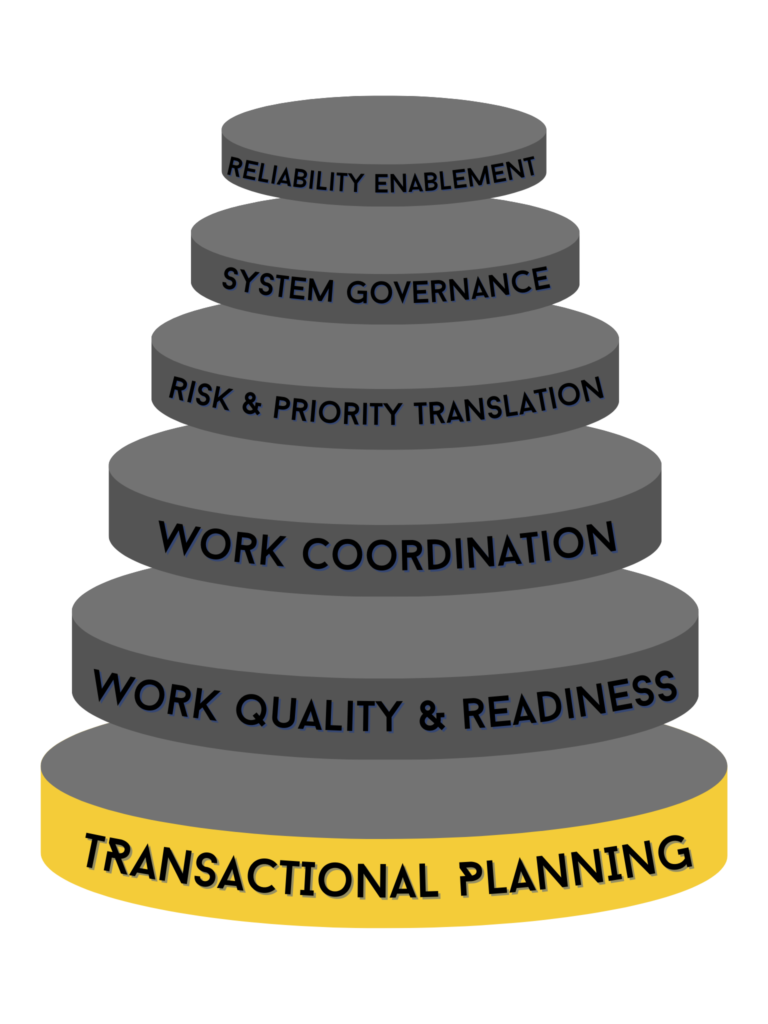
Transactional planning forms the foundation of the stack. This layer covers the administrative work required to keep the maintenance system functioning on a day-to-day basis.
It includes creating and updating work orders, maintaining status accuracy, routing requests, and ensuring basic system hygiene. When this layer is weak, work stalls, information degrades, and the rest of the planning process becomes unreliable.
While essential, transactional planning on its own has limited impact on performance. When planning roles are defined primarily around this layer, they are often viewed as reactive and administrative rather than enabling.
Transactional planning matters because it is the point at which maintenance intent becomes visible work. Without clean work order creation, accurate status updates, and basic system discipline, everything above it is built on unreliable information.
When this layer is weak, planners spend their time correcting errors, chasing missing information, and unblocking issues that should never have existed. Backlogs become misleading, reporting loses credibility, and trust in the CMMS erodes.
However, when organisations define planning only at this level, the role becomes trapped. The planner is valued for responsiveness rather than impact, and improvement work is crowded out by admin recovery. This is where many planning roles stagnate.
This layer matters not because it creates advantage, but because it prevents dysfunction. It is necessary, but not sufficient.
2. Work Quality & Readiness
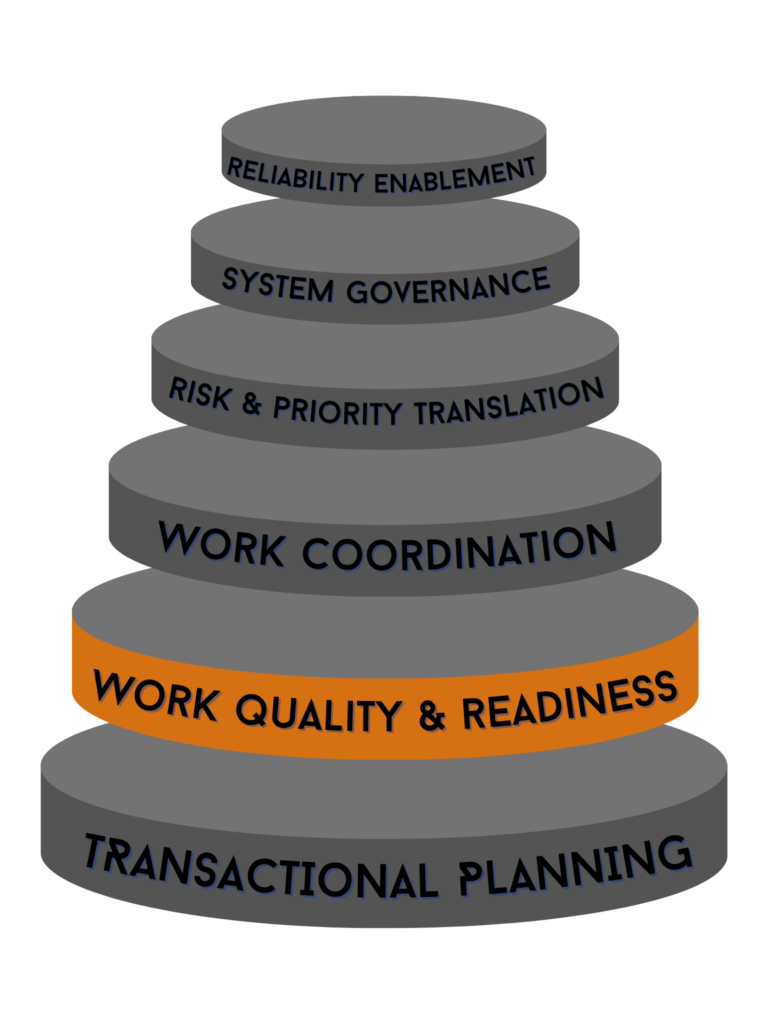
This layer focuses on turning vague or incomplete requests into executable work.
Work quality and readiness is about clarity. Scope is defined, the correct asset and trade are identified, durations are realistic, materials are confirmed, and access or safety requirements are understood before work is scheduled. The goal is to allow technicians to start and finish jobs without unnecessary delays or rework.
Strong performance at this layer improves schedule compliance, wrench time, and first-time fix rates. Weakness here leads to frequent job interruptions, repeated visits, and frustration in the field.
Work quality and readiness is where planning starts to directly affect execution performance.
Poor readiness creates the most common form of waste in maintenance: jobs that start but cannot finish. Missing materials, unclear scope, unrealistic durations, or incorrect access assumptions all translate into delays, rework, and frustration on the shop floor.
When this layer is strong, technicians trust the plan. Schedules become achievable rather than aspirational, and field execution becomes calmer and more predictable. Wrench time improves not because people work harder, but because less time is lost recovering from preventable issues.
This layer matters because it is the first point at which planning quality becomes visible to the workforce. It is also where planners begin to earn credibility beyond administration.
3. Coordination & Constraint Removal
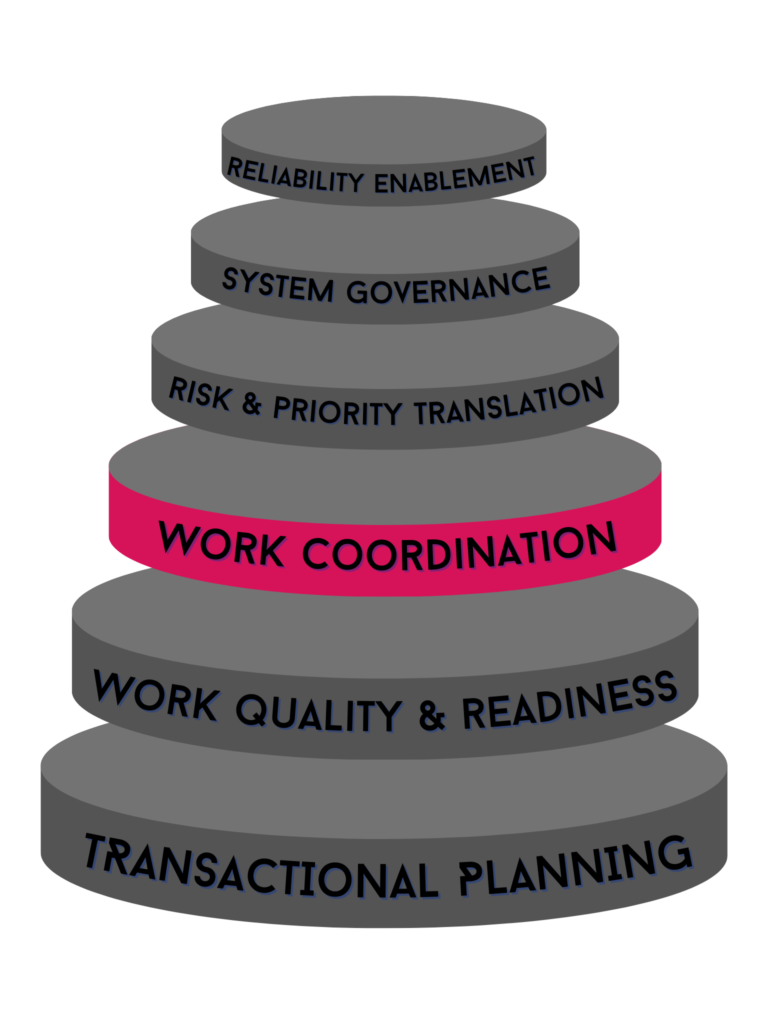
Coordination and constraint removal is where planning begins to enable flow rather than just prepare jobs.
At this layer, the planner identifies and removes barriers that prevent work from being executed as planned. This includes managing dependencies, confirming long-lead materials, arranging access and isolations, coordinating contractors, and aligning schedules with operations.
The focus shifts from individual jobs to the overall flow of work through the maintenance system. When done well, fewer jobs are cancelled or delayed, and execution becomes more predictable. When absent, even well-prepared jobs struggle to start on time.
Coordination and constraint removal is where planning moves from preparing work to enabling flow.
Most maintenance delays are not caused by poor job plans, but by unresolved dependencies: access not arranged, isolations not planned, materials arriving late, contractors unavailable, or production windows not aligned. Without deliberate coordination, these issues surface only when work is about to start.
This layer matters because it reduces firefighting. By identifying and removing constraints in advance, planners protect the schedule and reduce last-minute disruption. Execution becomes less reactive, and downtime is used more effectively.
At this level, planners begin to influence multiple jobs at once rather than optimising individual tasks. This is where planning effort starts to scale.
4. Risk & Priority Translation
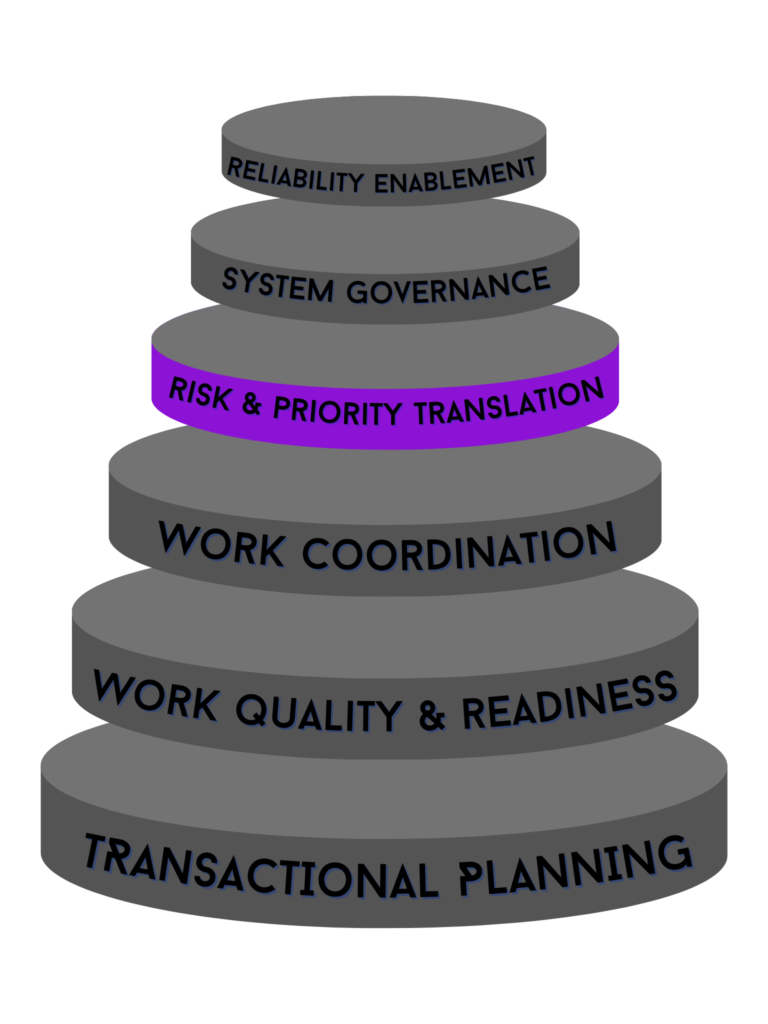
This layer centres on judgement and decision support.
Risk and priority translation involves converting defects, failures, and operational demands into a rational, defensible order of work. The planner helps distinguish between urgency and importance, makes trade-offs visible, and protects the schedule from constant disruption.
Rather than reacting to the loudest voice or the most recent issue, this layer introduces structure to prioritisation. It enables better alignment between maintenance, operations, and leadership, and builds trust in the planning process.
Risk and priority translation matters because most organisations do not suffer from a lack of work, they suffer from a lack of clarity.
Without a structured approach to prioritisation, maintenance schedules are vulnerable to emotion, urgency bias, and politics. Everything becomes “priority one”, emergency work increases, and planned work is constantly displaced.
This layer introduces discipline into decision-making. By translating defects, failures, and requests into risk-based priorities, planners help leaders make informed trade-offs rather than reactive choices.
When this layer is strong, the schedule is protected, escalation becomes purposeful, and trust increases between maintenance, operations, and management. Planning is no longer just preparing work, it is shaping decisions.
5. System Governance
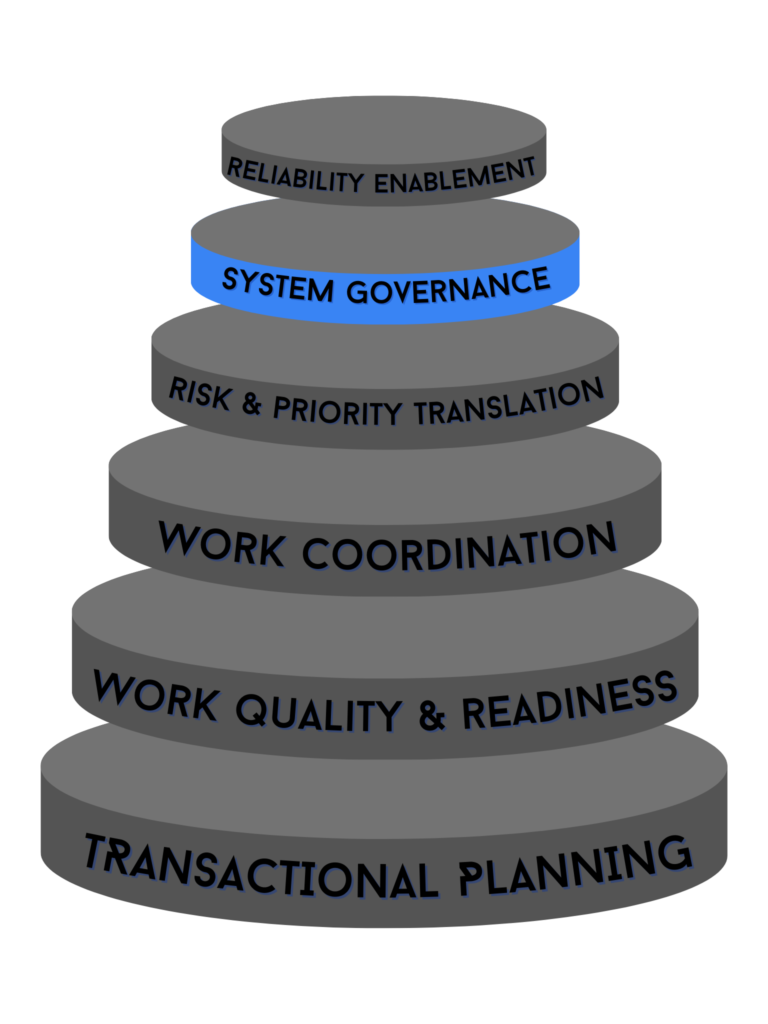
System governance is where planning becomes repeatable and scalable.
This layer focuses on defining and enforcing standards across the maintenance system. It includes data rules, workflows, templates, coding structures, training, audits, and change control. The aim is to reduce variation and ensure that planning quality does not depend on individual heroics.
Strong governance stabilises data quality, improves reporting credibility, and supports consistent execution. Without it, improvements decay over time and planning effectiveness varies widely between people and teams.
System governance matters because improvement does not sustain itself.
Without standards, workflows, and discipline, even good planning practices degrade over time. Data quality drops, templates drift, workarounds appear, and the CMMS becomes inconsistent. The organisation becomes dependent on individual planners rather than a reliable system.
This layer matters because it makes planning repeatable. Governance ensures that quality is embedded into the system, not reliant on personal effort or experience. It enables consistent reporting, faster onboarding, and scalable improvement.
When governance is absent, planning effectiveness varies wildly between teams. When it is present, planning becomes an organisational capability rather than a personal one.
6. Reliability Enablement
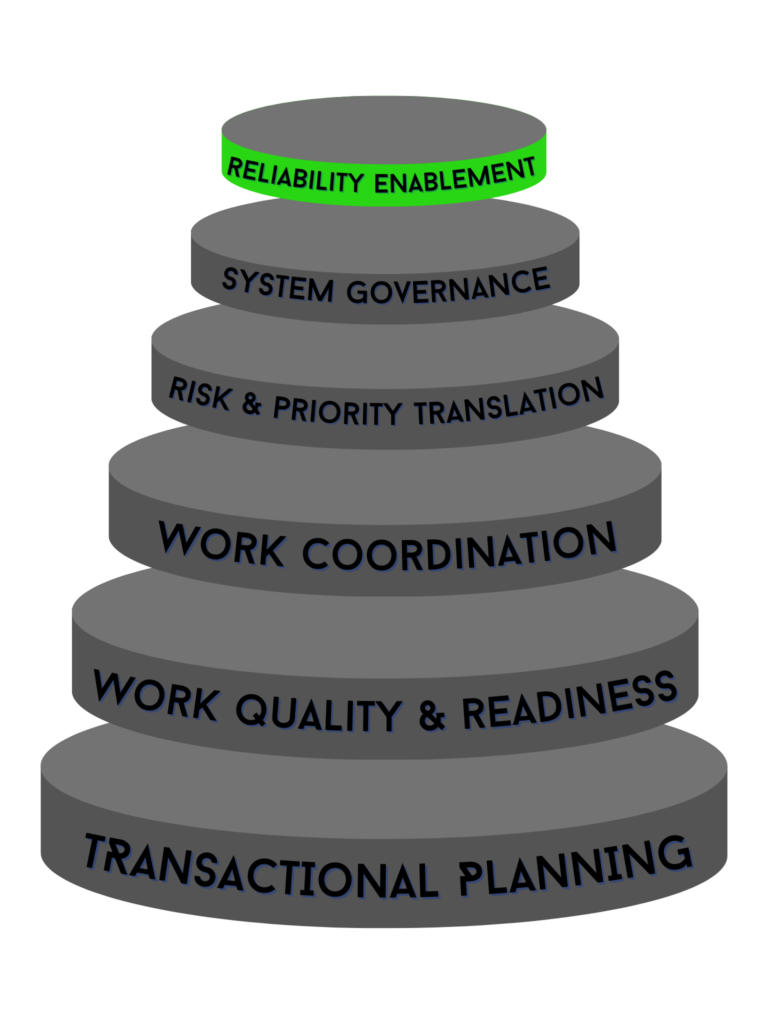
Reliability enablement sits at the top of the stack.
At this layer, planning outputs and CMMS data are used to support long-term asset performance. Planners help identify recurring issues, feed clean information into reliability activities, and ensure that improvement recommendations are converted into executable work.
This layer does not replace reliability engineering, but it enables it. By closing the loop between failures, planning, execution, and improvement, planners help reduce repeat defects and improve reliability outcomes over time.
Reliability enablement matters because execution alone does not improve asset performance.
Maintenance organisations often collect large volumes of data but struggle to turn it into meaningful improvement. Poor work history, inconsistent failure coding, and disconnected execution mean reliability initiatives stall or fail to land.
At this layer, planners act as the bridge between day-to-day work and long-term performance. By ensuring clean data, spotting patterns, and converting recommendations into executable work, planning enables reliability improvements to actually happen.
This layer matters because it closes the loop. Failures lead to insight, insight leads to action, and action leads to improved performance. Planning becomes a force multiplier for reliability rather than a downstream service.
How to Use the Planner Value Stack in Practice
The Planner Value Stack is designed to be a practical thinking tool, not a scoring system or a compliance model. Its value comes from how it is used in conversations, reflection, and role design.
For individual planners, the stack can be used to reflect on where most effort is currently spent. This is not about identifying a single layer, but understanding which layers dominate day-to-day work and which are missing or underdeveloped. In many cases, frustration in the role comes from being capable of higher-layer work but constrained by expectations, systems, or lack of authority.
For planning teams, the stack provides a shared language to discuss balance. Strong teams rarely operate at one layer alone. They maintain solid transactional foundations while deliberately investing time in readiness, coordination, prioritisation, and governance. The stack helps identify where effort is overly concentrated and where the greatest leverage sits.
For managers and leaders, the model helps clarify what is being asked of the planning function. If planners are expected to improve schedule compliance, reduce reactive work, or support reliability initiatives, the stack makes it clear which layers must be enabled and protected. Higher-layer work cannot exist if planners are consumed by basic recovery and administration.
The stack is also useful as a diagnostic tool. When performance issues appear, such as poor schedule adherence, constant reprioritisation, or unreliable reporting, the root cause is often a missing or underdeveloped layer rather than individual performance.
Used consistently, the Planner Value Stack helps shift the conversation from “what planners are doing” to “where planning effort is applied, and why that matters”.
What Comes Next
The Planner Value Stack is intended to be a shared reference point. It explains how planning value is created, why planning roles feel so different between organisations, and where the greatest opportunities for improvement typically sit.
To move beyond theory and into practical insight, the framework is now supported by the Planner HQ Value Stack Self Assessment – a structured self-assessment built directly from the definitions and principles outlined on this page. The diagnostic helps planners identify their current maturity level across all six layers and highlights where focused effort will deliver the greatest impact.
The model can continue to be used as a discussion tool, a diagnostic lens, and a way to bring structure to conversations about planning capability, expectations, and system design. The diagnostic simply adds measurable clarity to that conversation.
By making planning value visible and assessable, the Planner Value Stack helps move the role beyond administration and toward sustained performance improvement.