
A maintenance backlog can either be a sign of healthy forward planning or a red flag that signals inefficiency, misalignment, and missed opportunities. The difference lies in how the backlog is structured, managed, and audited.
For many organisations, maintenance backlogs grow quietly — unnoticed until they impact uptime, force teams into reactive work, or skew KPI reporting. This is where a backlog audit becomes an essential maintenance planning tool.
To improve that we are looking into:
- What a backlog audit is and why it matters.
- How to perform a step-by-step audit of work orders.
- How insights from backlog reviews can improve CMMS data quality and planning outcomes.
- Links to strategies from The Maintenance Planner’s Playbook that can help you tackle these challenges.
Why Auditing Your Maintenance Backlog Matters
A backlog audit is not just a numbers exercise. It reveals deeper operational truths about the health of your maintenance strategy, like:
- Are we prioritising correctly?
- Is our CMMS data accurate and up to date?
- How much work is “ready-to-schedule” versus “waiting on planning or parts”?
A well-audited backlog ensures that planners, schedulers, and technicians are focusing on value-adding tasks instead of spinning wheels on outdated, unclear, or low-priority work.
The 6 Steps To Audit and Improve your Work Order Backlog
Step 1: Define Backlog Health Metrics
Before diving into the backlog, you need to define what “good” looks like for your organisation. Examples include:
- Backlog Age: Jobs older than 90 days (non-critical) should be reviewed or closed.
- Backlog Volume vs. Labor Capacity: Many planners use the 4-6 week rule — if your total man-hours exceed this, prioritisation is needed.
- Percentage of Ready-to-Schedule Jobs: Ideally, 80% or more of your backlog should be fully planned with parts, permits, and instructions.
Related reading: 5 Reasons Your Maintenance Planning Might Be Failing.
Step 2: Categorise Work Orders
Using your CMMS, filter and group work orders:
- Critical vs. Non-Critical Assets
- Planned vs. Reactive Work
- Awaiting Parts / Awaiting Planning / Ready-to-Schedule
This snapshot tells you if your backlog is cluttered with unplanned or poorly scoped jobs, which is a common problem in reactive cultures.
Step 3: Audit Data Quality
A backlog audit is a great opportunity to clean your CMMS data. Check for:
- Duplicate or vague work orders (e.g. “Check pump” isn’t helpful – what are we checking for, what issue is suspected, etc…).
- Missing asset tags or location info.
- Work orders with no defined scope or estimated labor hours.
If you find recurring data quality issues, this is a sign of misuse of the planning role — something we explore in Why Is the Maintenance Planning Role Misused.
Step 4: Review and Prioritise
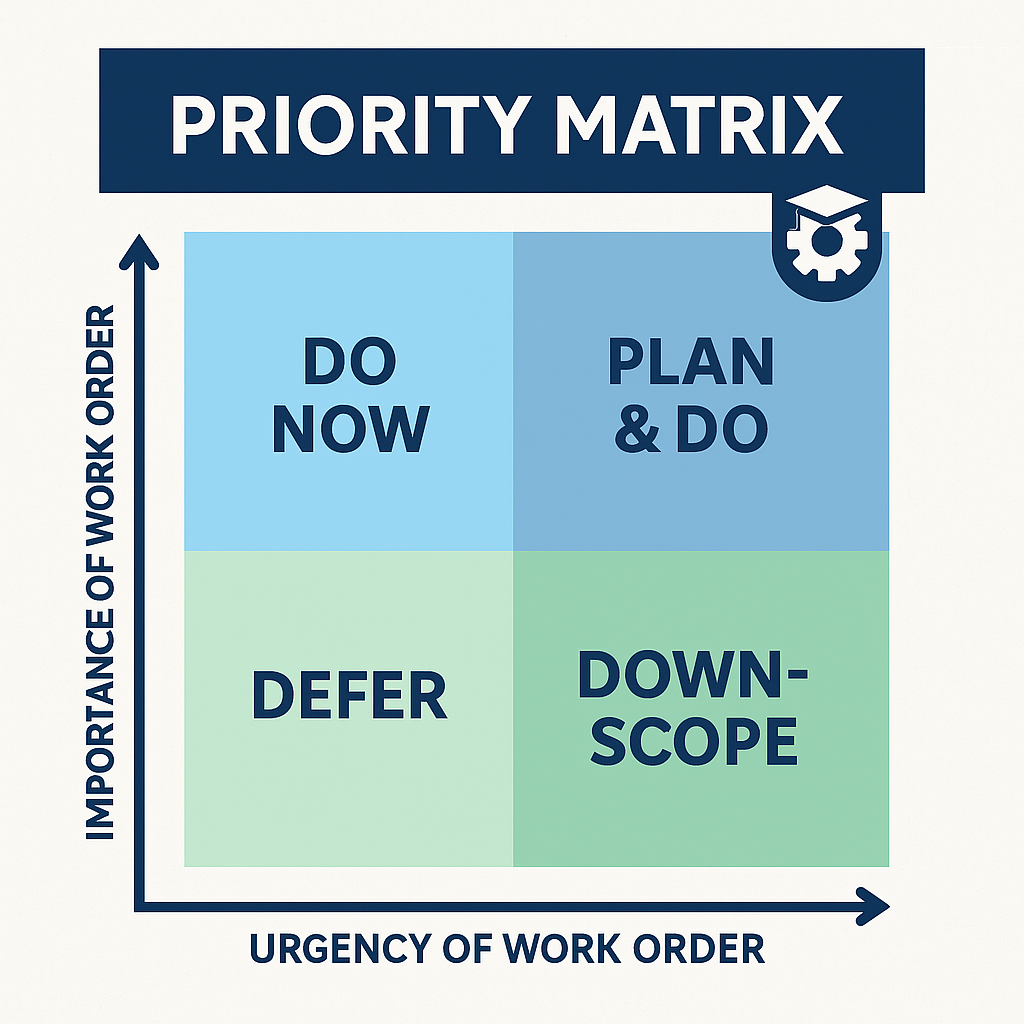
Once your backlog is clean, prioritise it all based on key factors to your team, for example:
- Asset criticality (impact on production, safety, compliance).
- Failure history and risk.
- Availability of resources (parts, tools, technicians).
Use a priority matrix to help assign clear priorities. A model like the below can help put things into actionable buckets to drive the plan:
Step 5: Close Out or Archive Stale Work Orders
If a work order has been open for six months with no action — does it still need to be done? Take time on this step to ensure nothing critical is closed, but be willing to proactively clean up the backlog so you are left with a useful list of works which genuinely require action:
- Close out obsolete or duplicate work orders.
- Merge overlapping tasks into preventive maintenance (PM) routes.
- Use a “backlog reset” session if your list is completely unmanageable.
Step 6: Build a Backlog Audit Routine
A backlog audit isn’t a one-off job, strong maintenance planners integrate this into a monthly or quarterly review cycle to maintain a healthy backlog:
- Run CMMS reports by age and priority.
- Share findings with operations and leadership.
- Adjust PM schedules or job planning processes based on trends.
The Planner’s Role in Backlog Improvement
A backlog isn’t just a list of unfinished work — it’s a reflection of how effectively a planner is driving structure, communication, and execution across the maintenance process. The planner is the bridge between chaos and control, and backlog management is one of the clearest indicators of their impact.
1. Championing Job Readiness
A key responsibility of the planner is ensuring that 80% or more of backlog work is “ready-to-schedule.” This means every job in the queue should have:
- A clear scope of work and defined outcomes.
- Accurate labor estimates and required skillsets.
- A fully validated parts list and kitting instructions.
- Permits, drawings, and tools ready ahead of time.
When jobs aren’t planned properly, they sit stagnant in the backlog — creating bottlenecks and frustration.
2. Filtering Noise from Value
Planners must regularly review the backlog to identify duplicate, vague, or low-value work orders. They act as the “quality gatekeeper,” ensuring that every job logged into the CMMS deserves the time and resources allocated to it. This reduces backlog clutter and keeps the focus on work that drives reliability and performance.
3. Coordinating Priorities with Operations
An effective planner actively collaborates with operations to align on priorities. They don’t just look at the backlog in isolation; they balance criticality, production schedules, and resource availability to make sure the most impactful tasks are executed first.
4. Using Data to Drive Continuous Improvement
Backlog data tells a story. A good planner regularly analyses:
- Which jobs are repeatedly postponed — and why.
- Trends in PM compliance and overdue work.
- Gaps in the planning process that lead to unplanned jobs clogging the backlog.
By using this insight, planners can improve job plans, adjust PM intervals, or recommend root cause analysis for recurring failures.
5. Communicating Progress and Accountability
Backlog improvement isn’t done in isolation. Planners play a vital role in communicating backlog health to leadership, operations, and maintenance teams, often using KPIs like backlog age or schedule compliance to show progress. This builds trust in the planning process and ensures alignment across departments.
Conclusion: Turning Backlog Audits into a Reliability Tool
A clean, well-prioritised backlog is a sign of proactive maintenance culture. It ensures that:
- Technicians spend more time on value-adding tasks.
- CMMS reports are accurate and useful.
- Emergencies are reduced because preventive work gets done.
A backlog audit is not just housekeeping — it’s a strategic activity that supports better planning, scheduling, and reliability outcomes.
To take this further, The Maintenance Planner’s Playbook includes step-by-step backlog audit checklists and thorough CMMS guidance designed to make this process repeatable and efficient.
Looking for a ready-to-use toolkits and checklists? ✅ Download our free toolkit here to get started.