
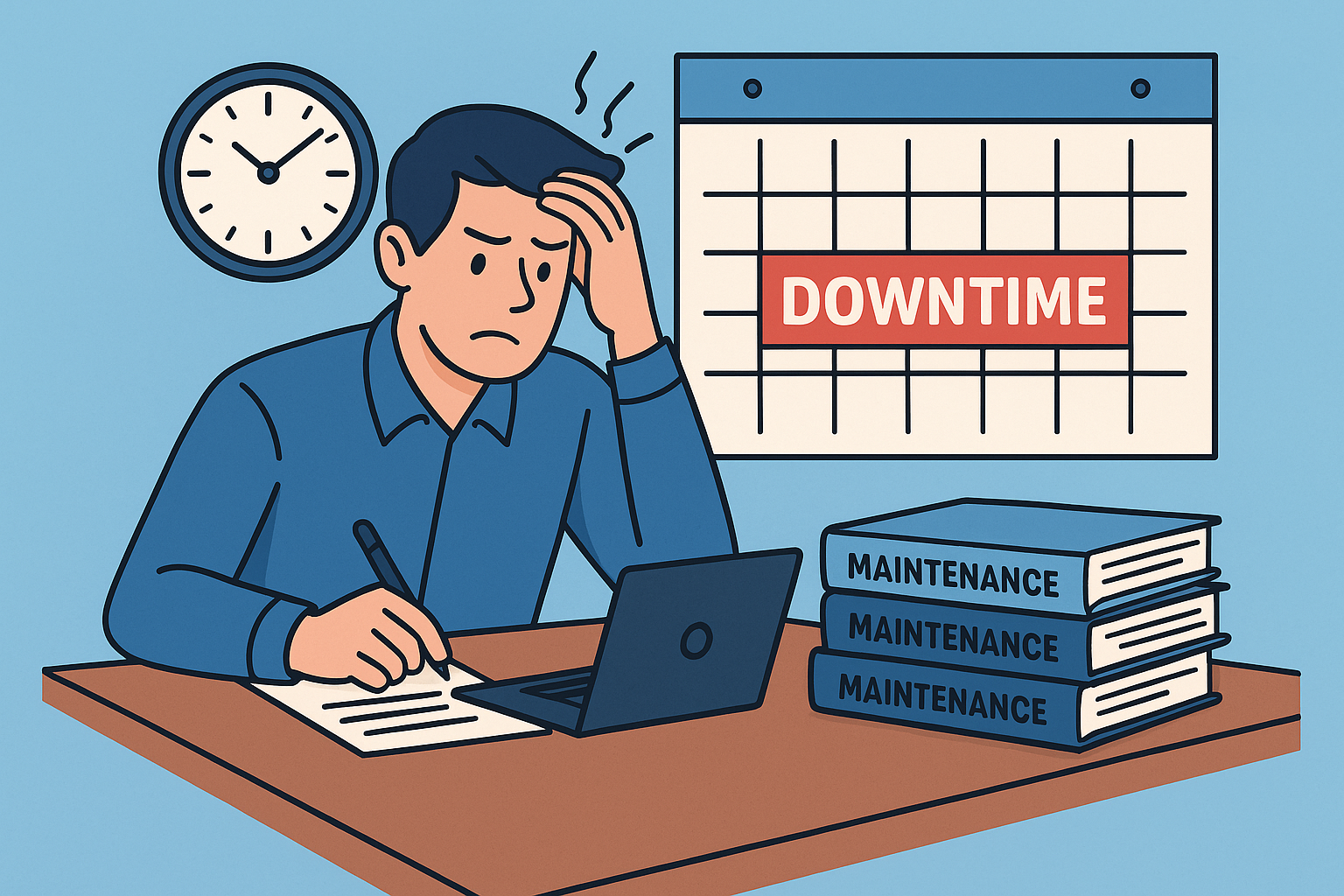
There’s a particular kind of pressure that comes with planning for a maintenance downtime window.
It’s not like planning a regular job. There’s more at stake, and fewer chances to get it wrong. The window opens… and the clock starts. From that moment, every minute counts. You don’t get an extension. You don’t get a second run. The plan either works — or it doesn’t.
Ask any experienced planner, and they’ll tell you: few things test your skill like a tightly scheduled shutdown.
Whether it’s a six-hour production window, a weekend line stop, or a hard-agreed outage that operations has fought to minimise, downtime periods are where all your preparation comes to a head. The difference between smooth execution and reactive chaos often comes down to the planning.
Downtime feels different — because it is
In theory, all planned work deserves the same attention to detail. But the reality is that downtime planning demands a different mindset.
You’re usually trying to compress multiple tasks — often disruptive, invasive, or complex ones — into a timeframe that barely feels long enough for one. And you’re rarely working alone. Vendors, contractors, internal trades, operations… everyone converges on the asset the moment it’s shut down.
Suddenly, your plan isn’t just a set of job steps. It’s a logistical event, an orchestration. One minor clash or delay, and the whole schedule starts to wobble.
You might have a perfect job plan on paper — but if the scaffold crew turns up late, or access to the work area is blocked, or the permit system is delayed, everything slips. And in a downtime window, there’s no room to make it up.
It all starts with scoping — real scoping
Good planning always begins with clear scoping, but when downtime is involved, there’s no room for guesswork or gaps.
You have to know exactly what the job involves. What access is required. What permits will be needed. Which isolations must be done in advance. Whether the drawings are current. Whether the spare parts are available. Whether the technicians understand what they’re walking into.
It’s not just about listing parts and estimating durations. It’s about imagining the work unfolding step by step and thinking through where it could go wrong.
In some environments, the best planners will walk the job ahead of time with the technician or supervisor, even if the work isn’t happening for another two weeks. They’ll take photos, ask awkward questions, and challenge assumptions.
That extra hour of thinking up front can save you five during the actual shutdown.
Not everything fits — and that’s okay
One of the biggest challenges with planning a downtime window is that people want to throw everything into it.
“Since we’ve got it offline anyway…”
“While we’re in the area…”
“We should probably squeeze this in too…”
It’s understandable — everyone wants to make the most of the opportunity. But not everything can (or should) fit.
An effective planner knows how to say no. Or more specifically, how to say, “Not this time — and here’s why.”
Downtime work should be prioritised based on necessity, access constraints, and risk. Some tasks simply aren’t justified in the window. Others can be scheduled separately. Your plan needs to reflect a logical order of importance, not a wishlist from every department.
Overloading a downtime plan is one of the fastest ways to fail it.
Planning for flow, not just tasks
One of the subtle shifts you make as a more experienced planner is learning to think in terms of flow.
It’s not just about getting all the tasks in — it’s about making sure they can actually happen, in the right order, without interference.
That means thinking about where each team will be working. Whether scaffold will block access for another job. Whether lifting operations need to happen before other work starts. Whether one team will be waiting on another to finish. Whether lighting, space, or safety controls will limit what can be done in parallel.
You can have the right people, parts, and job plans ready… but if two jobs need the same piece of access equipment at the same time, you’re stuck.
Flow is what separates a usable plan from a theoretical one.
Communication is half the plan
If the only person who truly understands the plan is you, then it’s not a plan — it’s a risk.
Downtime work needs to be communicated like a project. It needs to be walked through. Talked through. Challenged and clarified. Everyone involved — from operations to maintenance to contractors — should know what’s expected, what the sequence is, and what the critical path looks like.
Pre-shutdown briefings are invaluable. Even a simple 15-minute meeting with the team leads can highlight misunderstandings before they become costly delays.
Don’t assume people will read the work order and instantly get it. You’ve spent days or weeks building this plan — they’ve just opened it that morning. Talk it through. Bring the plan to life.
And don’t forget to leave space to breathe
This one’s easy to overlook, especially when you’re trying to maximise every possible minute. But the best downtime plans leave a little breathing room.
Because something always shifts.
A task takes longer than expected. A fitting doesn’t line up. A permit gets delayed. A contractor turns up late. It’s not poor planning — it’s just real life.
If your schedule is stacked wall-to-wall with no flexibility, you’ll feel every bump. But if you’ve left some room — even 15–30 minutes of buffer around key milestones — your plan becomes resilient. And resilience is what gets you to the finish line without scrambling.
Final word
Downtime windows are where great planners show their value.
They’re stressful, yes. But they’re also the best chance you get to show what proper planning can really achieve.
When the work is well-scoped, realistically prioritised, thoughtfully sequenced, and clearly communicated — it shows.
Technicians move confidently. Supervisors aren’t chasing. Work flows.
And you walk away from the shutdown knowing it was done right.
Not by chance. Not by luck.
By planning.