CMMS. Four letters that get thrown around in every maintenance meeting, yet often misunderstood. Some companies think of it as just another piece of software. Others assume that once it’s installed, their maintenance problems will magically disappear. And then there are those who still don’t use one at all.
For a maintenance planner, the CMMS is more than a digital filing cabinet. It’s the backbone of planning. It’s the system that makes backlog management possible, job plans structured, and scheduling disciplined. Without it, planning becomes a guessing game.
This article breaks down what a CMMS really is, what life looked like before it existed, the benefits it brings, and why it matters so much from the planner’s point of view.
What Is a CMMS?
CMMS stands for Computerised Maintenance Management System.
At its core, a CMMS is a database. It holds information about assets, work history, spare parts, preventive maintenance schedules, and job plans. However, it’s more than just data storage. A CMMS structures that information in a way that supports day-to-day maintenance management, and provides many interactive elements to make it the essential day-to-day digital tool for world class maintenance departments.
Think of it as the digital engine room for maintenance. Work requests come in, they’re planned and turned into work orders, parts are linked, tasks are assigned, and when work is completed, the results are captured. That closed loop is what makes the system valuable.
Unlike an ERP, which manages the wider business, the CMMS is very focused in its purpose. It’s the system designed specifically to keep assets running and maintenance controlled.
Life Before CMMS
To appreciate the value of a CMMS, it helps to imagine what came before.
Picture a planner in the 1980s. Their desk is buried under paper work orders. The backlog is managed on a whiteboard, wiped clean at the end of each week. Job histories are stored in filing cabinets that nobody has the time to dig through. If a technician needs a part, they call the stores, and if the stores clerk remembers seeing it on a shelf somewhere, maybe it gets found.
This wasn’t ancient history. Many companies operated like this well into the 2000s. Some still do. And even in organisations that have invested into a CMMS, the system is often underused — treated like a glorified spreadsheet rather than the all round engineering management tool it should be.
For planners, that paper-driven world meant wasted time and guesswork. Preparing a job plan required chasing down drawings, manuals, and history from whoever might have it. The lack of visibility made scheduling a shot in the dark.
The CMMS was designed to change all of that.
The Benefits of a CMMS
A well-implemented CMMS transforms maintenance. For planners, the benefits fall into several categories.
Work Management
- Work requests can be logged, triaged, and turned into work orders.
- Job plans can be attached, complete with tasks, materials, and permits.
- Supervisors can assign jobs with confidence that the preparation is done.
Visibility and Control
- Backlog can be seen, filtered, and prioritised.
- Planners know what’s ready to schedule and what’s missing.
- Operations can see upcoming work, reducing surprises.
Data and Improvement
- Every completed job adds to the asset history.
- Failure codes and downtime are captured for analysis.
- Trends become visible, feeding reliability improvements.
Integration with Stores and Supply Chain
- Parts can be linked to job plans and reservations raised.
- Stock levels can be managed against demand.
- Lead times are visible, avoiding last-minute delays.
The common theme is simple: the CMMS creates structure. Instead of information being scattered in spreadsheets, notebooks, and people’s heads, it’s centralised. That structure is what allows planners to do their job properly.
For more on why data quality inside the CMMS is so critical, see CMMS Data Quality – The Hidden Engine of Planning.
Why CMMS Matters to Planners
Planners don’t just use the CMMS, they practically live inside it.
From the planner’s perspective, the CMMS is where the role comes to life:
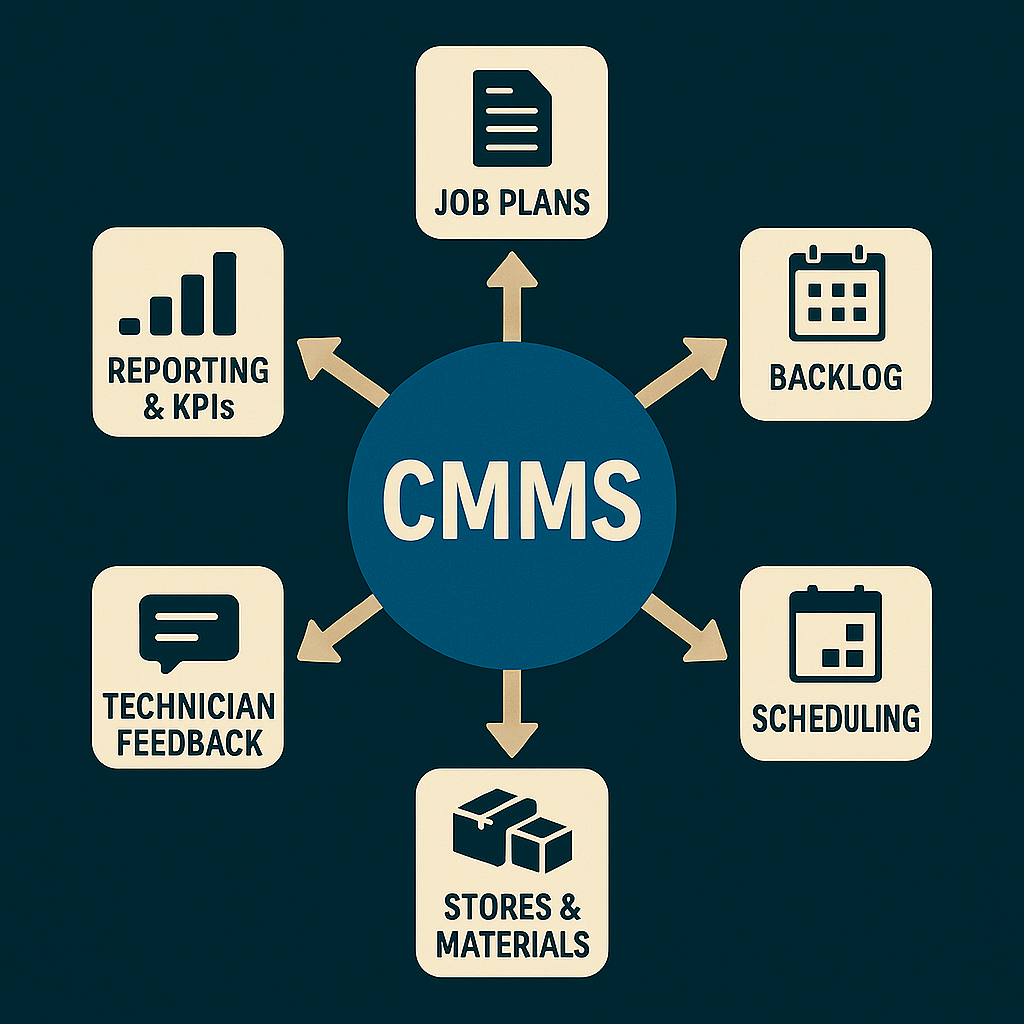
- Job Plans: templates, task lists, and bill of materials are built, stored, and reused.
- Backlog Health: planners can define what’s ready-to-schedule and make sure the pipeline is clean.
- Scheduling Support: supervisors and schedulers rely on planners to hand over complete, executable work orders.
- Continuous Improvement: work order feedback loops feed the planner’s ability to refine job plans and improve accuracy.
Without a CMMS, or with a poor one, this cycle breaks down. Planners are reduced to chasing paperwork or doing admin instead of real planning. With a good CMMS, planners can focus on the activities that truly drive efficiency.
Misconceptions and Pitfalls
It’s easy to oversell or misuse a CMMS. Here are some of the most common traps.
The Silver Bullet Myth
Installing a CMMS doesn’t fix maintenance. It’s a tool, not a solution. Processes, discipline, and people matter more than the software.
Underutilisation
Many companies only use a fraction of their CMMS capability. They buy a system with advanced features but use it like a basic work order tracker. The investment is then wasted, and the true value is lost.
Overcomplication
The other extreme is drowning the planner in data entry. Too many mandatory fields, too much admin, too little focus on execution. When planners spend more time feeding the system than preparing jobs, something has gone wrong.
Planner as Administrator
One of the biggest risks is when planners are turned into CMMS administrators — entering work orders, closing jobs, raising purchase orders. These tasks might live in the system, but they’re not planning.
For more on how misuse undermines planning, see Why the Maintenance Planning Role Is Misused.
The Planner’s Perspective
For a maintenance planner, the CMMS is not just another piece of software, it’s the stage on which the whole planning role plays out. Every strength or weakness in the system ripples directly into how effective a planner can be.
A planner’s day is shaped by the CMMS in ways that often go unnoticed:
- Clarity of Backlog
A clean backlog in the CMMS means a planner can focus on building readiness instead of firefighting. When the backlog is messy, unclear, or overloaded with duplicates, planning loses its grip. - Job Plan Reuse
The CMMS is the library where great job plans live. Without it, planners spend their time reinventing the wheel. With it, planners can build once, refine with feedback, and reuse many times — a force multiplier for efficiency. - Integration with Stores
For planners, nothing kills credibility faster than handing a supervisor a job package missing critical parts. A CMMS that connects seamlessly with stores allows the planner to guarantee that jobs are both prepared and executable. - Feedback Loops
A CMMS isn’t just about pushing work out — it’s about pulling learning back in. Planners depend on technician feedback to improve job plans. Without a structured system to capture that feedback, the loop breaks, and planning stagnates. - Schedule Readiness
A planner’s output is not the work order itself, but the confidence that work is ready to schedule. The CMMS provides the definition of ready — a way to show which jobs have everything lined up, and which still need preparation.
The planner’s relationship with the CMMS is therefore both strategic and practical. Strategic because the system defines what planning means in the organisation. Practical because every job plan, every backlog decision, every piece of technician feedback passes through it.
At Planner HQ we stress this point: the CMMS should never reduce a planner to a data-entry clerk. Its purpose is to give planners the tools, visibility, and confidence to drive execution quality. When the CMMS is treated as an enabler, not a burden, the planner role delivers its full value.
From System to Strategy

A CMMS is only as valuable as the planning discipline that surrounds it. For planners, that means more than knowing which buttons to click. It means understanding how to structure a backlog, prepare job plans, build schedule readiness, and turn data into reliability improvements.
That bigger picture is exactly what The Maintenance Planners Playbook was written for. The book goes beyond systems and software to show how planners create real organisational impact — with or without the latest CMMS features.
If this article gave you a useful foundation, the Playbook will take you further. It’s a practical guide to mastering the planning role and making tools like the CMMS work in your favour.
Discover The Maintenance Planners Playbook here.
Key Points
- A CMMS is a Computerised Maintenance Management System — the digital backbone of maintenance.
- Before CMMS, planning was manual, fragmented, and inefficient.
- The benefits include work management, visibility, data-driven improvement, and integration with stores.
- For planners, the CMMS is the central tool for job plans, backlog health, and schedule readiness.
- Misuse and overcomplication are common pitfalls — the system should support planning, not replace it.
- Success depends on planners treating the CMMS as an enabler, not an end in itself.
Closing Insight
A CMMS on its own doesn’t deliver results. But in the hands of a skilled planner, it becomes the system that turns chaos into control.
It’s the planner’s canvas, toolkit, and memory all in one. When used well, it doesn’t just store information — it drives better work execution, smoother schedules, and stronger reliability.
For planners who want to go deeper, CMMS Mastery will soon provide the step-by-step guide to turning any CMMS into a genuine performance tool. Until then, this cornerstone post gives you the foundation: what a CMMS is, why it matters, and how planners can make the most of it.
For those interested in taking this further, reliability expert Ricky Smith has an excellent article on 9 Helpful CMMS Implementation Steps to Achieve Long-Term Success. It’s a practical guide that complements this piece by showing how to move from theory into effective implementation. Well worth a read alongside this planner-focused perspective.