
One of the quiet but critical elements of any good maintenance strategy is spare parts management.
It’s not flashy. It doesn’t grab attention.
But when it’s not done well?
Everything else — job planning, scheduling, technician productivity — starts to fall apart.
Spare parts are the invisible glue that holds planned work together. And as a planner, even if you’re not directly managing the stores, you’re absolutely relying on that glue every day.
So how do you make sure your spare parts setup is helping — not hindering — the work you’re trying to plan?
It starts with a simple question: what do we actually need to hold in stock?
Not every part should be sitting on a shelf.
That might sound obvious, but in a lot of plants and workshops, parts are added to inventory reactively — after a breakdown or a scare. And then they stay there. Forever.
You end up with thousands of items, many of which are rarely used, tying up cash and cluttering up stores.
Meanwhile, the parts that really matter — the ones that actually impact job readiness — might be missing altogether.
The better approach is to work with your stores or procurement team to look at usage data, failure trends, and lead times. Ask questions like:
- Which parts are used most often in our planned jobs?
- What would seriously delay a critical job if we didn’t have it?
- Are there parts that are shared across many pieces of equipment?
- How long does it actually take to get this part if we order it today?
You don’t need to make perfect decisions straight away.
But you do need to be intentional. Otherwise, the chaos builds quietly in the background.
Min/max levels: helpful — but only if they’re grounded in reality
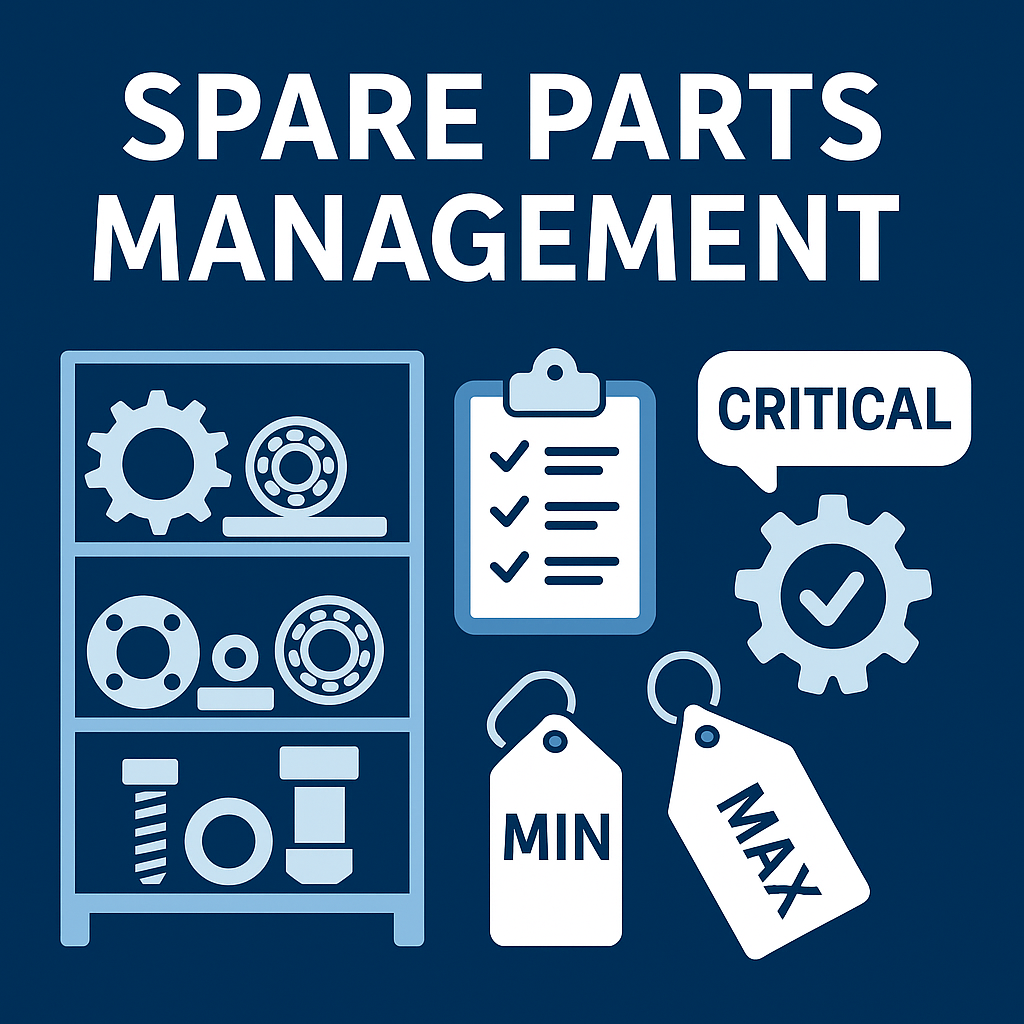
Min/max stock levels sound great on paper.
They give structure. They automate reordering. They make it feel like things are under control.
But if your min and max figures are guesses — or worse, copied from another site or inherited from five years ago — then the system is just pretending to help you.
Start simple.
If you know a particular bearing gets used every month and takes two weeks to arrive, set a minimum that gives you a safety buffer.
Set a max that reflects how many you’re likely to need before the next delivery.
If you don’t have data?
Use job plans. Use technician memory. Use something more informed than “well, we’ve always kept 12.”
Min/max levels should evolve. Review them annually if nothing else. That process alone will reveal where your parts management is helping or hurting the plan.
Reorder points, reorder quantities — and why both matter
One trap that’s easy to fall into is confusing reorder points with reorder quantities.
The reorder point tells you when to act.
The reorder quantity tells you how much to order.
You might be triggering orders at the right time — but buying too little (and running short again) or too much (and overstocking).
If you’re using a CMMS or inventory system to manage this, make sure both fields are being used properly.
And if you’re not using those features yet?
This is a good place to start. Even a basic reorder system beats the alternative: realising you’re out of a key part halfway through a planned job.
Criticality is the context
A part is only “critical” in context.
That’s why tagging parts by criticality can be such a useful habit.
When a part is genuinely critical — meaning it would bring down a key asset and delay production or cause safety issues — you probably want it in stock.
If it’s low-cost and high-impact, it’s a no-brainer.
On the other hand, if it’s rarely used, easy to source, and not essential to core operations? You might not need to carry it at all.
Having some kind of criticality tagging — even just high/medium/low — helps align your stores with your planning priorities.
It also makes it easier to justify stock decisions to finance or procurement teams who may not understand why that weird little coupling is so important to have “just in case.”
Spare parts strategy is a living thing
The most important thing to remember is this: You’re never done with spare parts management.
It’s not a one-time setup. It’s not a spreadsheet you tidy up once a year.
It’s a system that interacts with your job plans, your PM program, your failure history, and your people — every single day.
So make it visible. Talk about it. Walk the stores occasionally. Review usage with technicians.
Don’t wait until a planner goes to issue a part, and finds an empty bin, to realise there’s a problem.
Final thoughts
Good spare parts management isn’t just about saving money or cleaning up stores.
It’s about enabling planned maintenance to actually happen.
- Because when the right parts are in the right place —
- The job flows.
- The technician is confident.
- The downtime stays where it should be: under control.
And that’s what planning is all about.