Guest Article
Part of our Planner HQ Contributor Series, where we feature voices from the global maintenance and reliability community.
“Effective maintenance management does not happen by chance—it happens by design.”
Have you ever wondered why some companies excel in maintenance while others constantly struggle with inefficiencies? The answer often lies in their foundation. A well‑structured asset hierarchy is a critical building block for reliable maintenance, but without a proper numbering standard, even the best hierarchy can become confusing and inefficient. Numbering provides the logical structure that ensures staff can navigate, manage, and use the hierarchy effectively.
“The devil is in the details”—and in this case, the way we define things.
Clear, written standards and definitions are essential. They must be trained, followed, and updated as new insights emerge. These standards should create clarity and prevent confusion—so your staff isn’t left asking:
“What exactly are we giving asset numbers to anyway?”
This discipline is one of the most critical components of a successful and sustainable hierarchy and numbering system.

Why Numbering Matters
I previously defined asset hierarchy as a structured framework that organizes assets from broad systems down to individual components. The right level of detail depends on the company’s size and complexity: too little detail risks missing critical assets, while too much detail creates unnecessary administrative burden. The goal is balance—ensuring assets are identifiable, manageable, and efficiently supported by maintenance strategies, documentation, and inventory systems that empower your staff.
To manage assets effectively, you must be able to answer three key questions:
- What it is – Identifying the asset itself (manufacturer, model, serial number, etc.).
- Where it is – Locating it within the system, facility, or geographic area.
- What it does – Understanding its functional role in the system.
The first question – what it is – is addressed through asset naming standards and supporting documentation. So, asset naming standards must be thoughtfully defined.
At this point it is important to differentiate between the role of naming and documentation practices and asset numbering.
“The worst thing one can do is try to be all things to all people.”
An asset numbering system should help staff quickly locate assets and understand their purpose by showing where they sit in the hierarchy and how they relate to surrounding assets. It should not attempt to identify asset type, attributes, or physical location—that is the job of the naming standard. Mixing these functions will create unnecessary complexity and undermines the primary role of the numbering system.
Building on this foundation, we must now define the specific functions our asset numbering system should serve. These functions empower staff, reduce ambiguity, and ensure long‑term manageability of the hierarchy.
Purpose of Our Assets and Asset Numbers
The primary purpose of asset numbers is to enable logical organization of the hierarchy. Think of the hierarchy as a map of your organization or facility—replacing street names with functional systems. While the hierarchy groups assets into logical categories, asset numbers provide the structure to list systems and equipment in a clear, ordered way.
To achieve this, you must understand how your CMMS organizes asset lists. Most systems sort alphabetically and allow import/export to Excel for analysis and modification, so your numbering design should account for this behavior. A well‑designed numbering system ensures assets appear in a logical sequence, making them easy to locate and interpret.
For ease of navigation, personnel should be able to “step up or down” the hierarchy by adding or subtracting digits from lower‑level asset numbers. This allows staff to quickly trace equipment back to its parent system and related assets. For example:
- O – Organization
- OA – Facility 1
- OA1 – Auxiliary Systems
- OA11 – Plant Air System
- OA111 – Compressor Package
Once assets are grouped into their system or ‘streets,’ they should be ordered logically, just like street numbers. In process systems, this might follow product flow (infeed to outfeed). For non‑process assets, order could follow physical layout (west to east, north to south). Naming standards are important, but numbering reinforces clarity by reducing ambiguity and helping staff intuit where an asset is and what it does.
Within the Plant Air System, assets might be numbered:
- OA111 – Compressor Package
- OA112 – Manual Isolation Valve
- OA113 – Air Dryer
- OA114 – Automated Isolation Valve
- OA115 – Air Receiver
Even someone unfamiliar with the site can infer the system’s structure and purpose by reading the list.
Planning and Managing Asset Numbers
From the example above, it’s clear that asset numbers can run out quickly, making it difficult to add new assets later. This highlights the importance of planning your hierarchy and use of asset numbers in advance to ensure there is room for growth and to allow for modification if necessary.
Pro Tip Limit the use of asset numbers in documentation, HMIs, and programming. Once embedded in these systems, asset numbers become extremely difficult and costly to change if the hierarchy needs to be modified. Your numbering standard should clearly define where asset numbers may be used and outline the steps to follow if adjustments are required.
! Safety Matters
This is not a theoretical risk – it has led to serious incidents across industry. When systems become inaccurate, the consequences can be devastating. A staff member may believe they have locked out and tested the correct asset—only to discover they did not after the equipment unexpectedly turns on. This risk is rarely discussed, but it occurs far too often in industry.
To keep asset numbers short and easy to read, consider adopting numbering systems that extend beyond the decimal base (0–9). While decimal may be sufficient for very small facilities with simple systems, larger sites benefit from more compact numbering schemes such as:
- Hexadecimal – 0–F represents 0–15
- Base 32 – 0–V represents 0–31
- Base 36 – 0–Z represents 0–35
Beyond readability, asset numbers must also serve as unique identifiers. Just as duplicate street names can cause mail to be misdelivered or a cab to drop you at the wrong address, duplicate asset numbers create confusion, inefficiencies, and errors—especially in large or enterprise‑level systems.
Using numbers directly from P&IDs (e.g., P‑1, XV‑1) is not recommended for asset numbering. These identifiers are not unique or logically ordered, which leads to organizational issues. However, they remain valuable in naming standards and are well suited for HMIs and programming rungs, where stability is more important than flexibility.
Most robust CMMS systems prevent duplicate asset numbers. By starting at a high enough level and following a consistent numbering standard (e.g., OA111), you can ensure your asset numbers remain unique, logical, and aligned with the goals outlined in this guide.
Of course, planning ahead is only part of the equation. To apply your numbering system effectively, you also need to understand how your CMMS handles identifiers—and the difference between fixed and modifiable numbers.
Fixed vs. Modifiable Asset Numbers
Most CMMS platforms assign two types of identifiers when you create an asset:
- Fixed Number – A system‑generated identifier that never changes. This acts like a serial number, permanently tying all records, history, and data to the asset regardless of where it resides in the hierarchy.
- Modifiable Asset Number – A user‑defined identifier that can be adjusted. This serves as the street address, showing the asset’s current location within the hierarchy.
It’s critical to understand this distinction. The fixed number is the anchor for your CMMS, while the modifiable number provides navigational clarity. Confusing the two can create chaos. Just as cities and mapping systems rely on stable addresses, your hierarchy depends on consistent numbering to avoid disorder.
The modifiable asset number must belong to the hierarchy. Imagine the confusion if cities allowed residents to own their street addresses and take them with them when they moved—maps would break, deliveries would fail, and navigation systems would collapse. The same chaos occurs if hierarchy addresses are treated as portable identifiers.
Once you’ve clarified the role of fixed and modifiable identifiers, the next step is to define how numbers represent hierarchy levels. This ensures consistency and prevents numbers from becoming unwieldy as systems grow.
An Overlooked Standard
In the examples above, there is a built-in standard that is often overlooked: each number represents a specific level in the hierarchy. Writing this approach into your standard ensures consistency, prevents identifiers from becoming unnecessarily long, and keeps them easy to read and remember.
You can also adopt different numbering bases at different levels to further improve clarity. To make this effective, your standard should specify how many assets are allowed under each level and define what to do if that limit is exceeded—for example, creating asset numbers that represent smaller subgroups within a complex system.
Example: OA00111
- First digit (A–Z) – O → Organization level (e.g., Chemical Manufacturer X)
- Second digit (A–Z) – A → Site/Facility level (e.g., Facility X, Mississauga, Ontario)
- Third digit (Hexadecimal) – 0 → Area/Department level (0 = Plant Auxiliary Systems, 1 = Production Lines, etc.)
- Fourth digit (0–9) – 0 → System/Subdepartment level (0 = Electrical System, 1 = Plant Steam, etc.)
- Fifth digit (Base 36) – 1 → Subsystem/Equipment level (e.g., Main Transformer)
- Sixth digit (Base 36) – 1 → Sub‑equipment level (e.g., Cooling Fan)
- Seventh digit (Base 36) – 1 → Component level (e.g., Motor, more likely listed on the fan BOM rather than as its own asset)
Limiting the number of assets in a single list has the added benefit of improving usability. Smaller lists are easier to scan, making it quicker for staff to locate the right item. Of course, there is always a balance – it may not be possible or logical to limit every list. Still, consider how much simpler it is to find something in a list of 20 items compared to one with 2,000.
The best way to help people succeed is to make the system easy to use. The seemingly small choices made during setup can have a big impact on usability and, ultimately, on the success of the implementation.
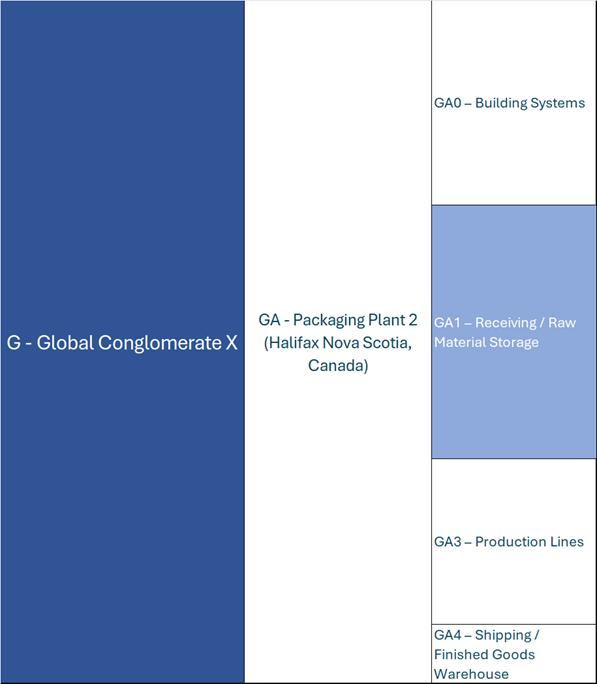
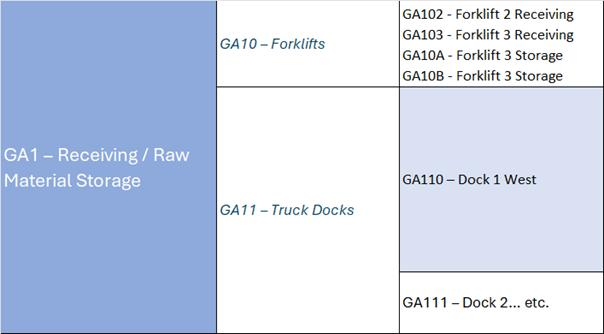
To see how these principles come together in practice, let’s look at a sample hierarchy for a packaging facility. This example illustrates how numbering cascades from global organization down to individual components.
Hierarchy Example
Below is a sample hierarchy for a fictitious packaging facility. It illustrates how numbering cascades from global organization down to individual components, ensuring clarity and consistency.
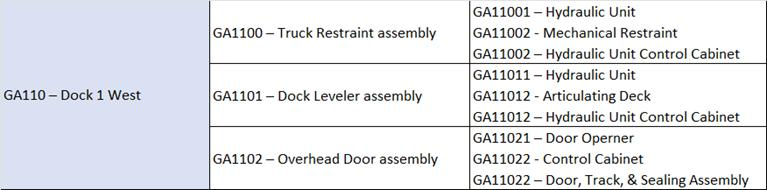
The Purpose of Asset Numbers
Asset numbers serve several critical functions in asset management:
- Logical Organization of Hierarchy / CMMS Ordering Since most CMMS systems organize lists alphabetically, asset numbers must be designed to maintain logical order (e.g., infeed to outfeed) so that the hierarchy reflects the actual system flow. Doing this reduces ambiguity enabling personnel to be able to infer the system’s structure and the purpose of assets simply by reading down the list of asset numbers.
- Ease of Navigation Personnel should be able to trace assets up and down the hierarchy by subtracting or adding digits (e.g., F111 → F11 → F1 → F). This makes locating equipment intuitive.
- Unique Identification Asset numbers act as unique identifiers, preventing duplication and confusion (similar to avoiding duplicate street addresses). This reduces errors in maintenance, work orders, and reporting.
- Scalability and Flexibility Proper numbering standards (decimal, hexadecimal, base‑32, base‑36) allow facilities to avoid “running out of numbers” and keep identifiers short and manageable, even in complex systems.
Conclusion
A numbering standard is far more than a clerical exercise—it is the backbone of a usable, scalable asset hierarchy. By designing numbers that are logical, unique, and easy to navigate, organizations create a system that empowers staff, reduces ambiguity, and supports long‑term reliability. When numbering is treated with discipline—planned in advance, consistently applied, and protected from unnecessary changes—it transforms the hierarchy into a living map of the facility.
The payoff is significant: maintenance teams spend less time searching, systems remain coherent as they grow, and decision‑makers gain confidence in the accuracy of their data. In short, effective numbering is not about digits on a page—it is about enabling operational excellence. Companies that invest in this foundation will find themselves better equipped to move from reactive firefighting to proactive, sustainable reliability practices.
Guest article
Mike Arsenault P.Eng, RSE, CET
Mike is a reliability and asset management leader with over 20 years of experience across marine, military, and manufacturing sectors.
A Red Seal certified Industrial Electrician and Millwright, and a licensed Professional Engineer, he specializes in building practical maintenance systems that empower the people who use them. Known for turning complex reliability concepts into engaging visual metaphors,
Mike calls out the costly pursuit of easy answers – advocating instead for the discipline, structure, and effort that actually move the needle, through sharp storytelling and grounded wisdom.
Connect with Mike on LinkedIn below

Mike Arsenault
Rockland Physical Asset Management