CMMS & DATA GOVERNANCE
The CMMS systems, standards, and behaviours that make planning scalable.
The CMMS systems, standards, and behaviours that make planning scalable.
CMMS & Data Governance focuses on how maintenance planning is supported, constrained, or enabled by systems and data. It covers how CMMS platforms should be configured, governed, and used in practice to reinforce planning discipline rather than compensate for its absence.
This pillar addresses a common reality: organisations often invest heavily in CMMS technology but struggle to realise its value. Without clear standards, ownership, and behavioural discipline, systems become repositories of noise rather than engines of decision-making.
PILLAR 3 // CMMS & Data Governance – Core Topics
CMMS purpose and design intent
CMMS platforms should reflect how work is meant to flow. This topic explores why understanding design intent matters more than feature depth, and how misaligned configurations create friction rather than control.
Asset Structure and Hierarchies
Asset hierarchies underpin maintenance planning, reporting, and reliability. This section focuses on structuring asset hierarchies in a way that supports planning decisions, data quality, and long-term analysis.
Work Order Config and Status control
Statuses, fields, and workflows shape overall CMMS behaviour. This topic addresses how work order design influences planning discipline, execution readiness, and data integrity, ultimately influencing reliability decision making.
Data Standards and Ownership
Data quality does not improve by accident. This section explores how standards are defined, who owns them, and how governance models prevent gradual degradation over time.
Adoption, Behaviour and Usability
Even well-designed systems fail if they are not used consistently. This topic focuses on adoption barriers, technician input, and how usability influences data reliability.
Governance Models
CMMS governance is ongoing, not a one-off project. This section introduces governance structures that maintain discipline, manage change, and protect planning integrity as organisations scale.
PILLAR 3 // Frameworks & Resources
The Planning Foundations pillar is supported by dedicated frameworks and long-form resources that explore these ideas in depth and translate them into practical thinking tools for planners and leaders.
These assets sit at the heart of this pillar.
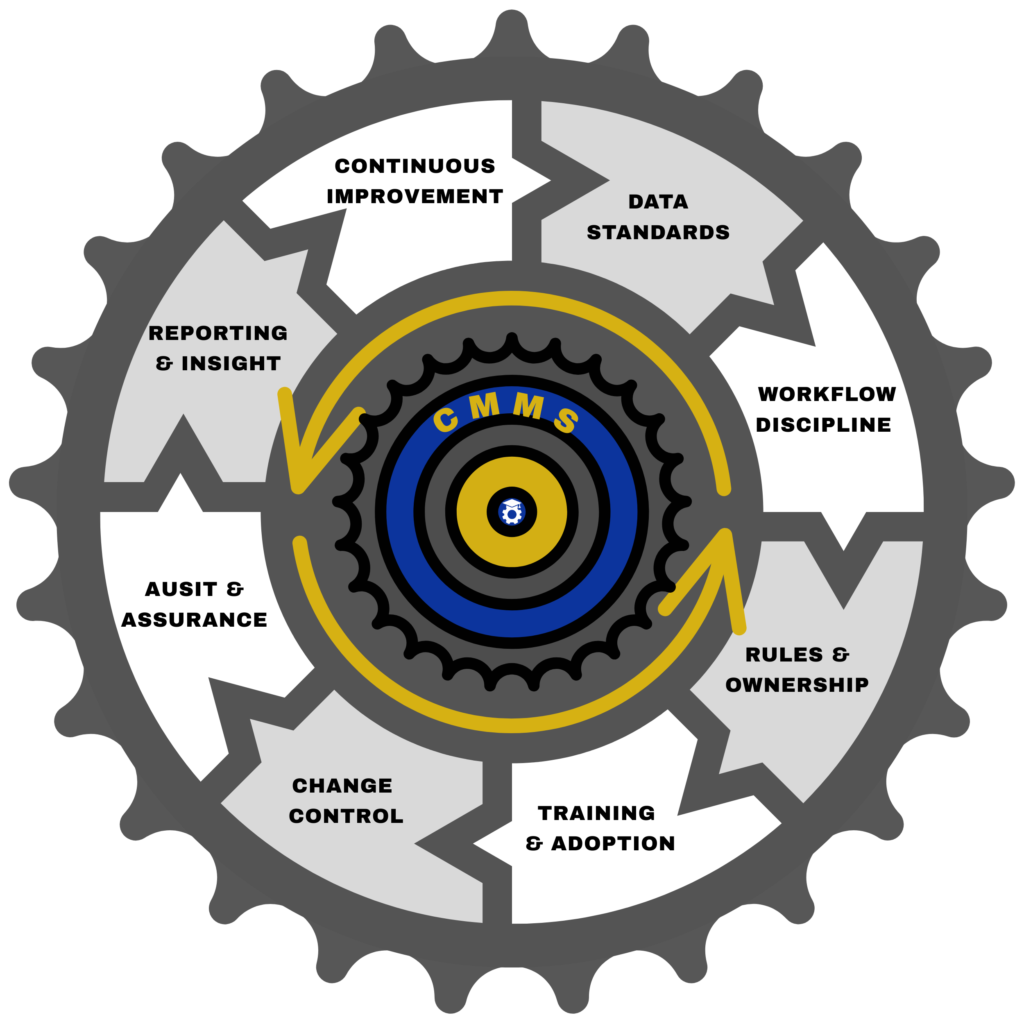
CMMS Governance Flywheel
The CMMS Governance Flywheel is a systems framework that explains how CMMS environments remain effective over time, and why they often degrade despite good intentions, capable people, and modern software.
It reframes CMMS performance as a governance challenge rather than a configuration problem. By focusing on the reinforcing controls that shape behaviour, data quality, and decision-making, the flywheel helps planners move beyond firefighting and towards long-term system stability.
The framework helps planners and CMMS specialists understand:
- Why recurring CMMS issues are often symptoms of weak governance, not isolated mistakes
- Which parts of the system quietly undermine planning quality, scheduling stability, and reporting credibility
- How data standards, workflows, ownership, and assurance interact as a single system
- Where to focus improvement effort for the greatest stabilising effect
- Why fixing one problem at a time rarely delivers lasting results

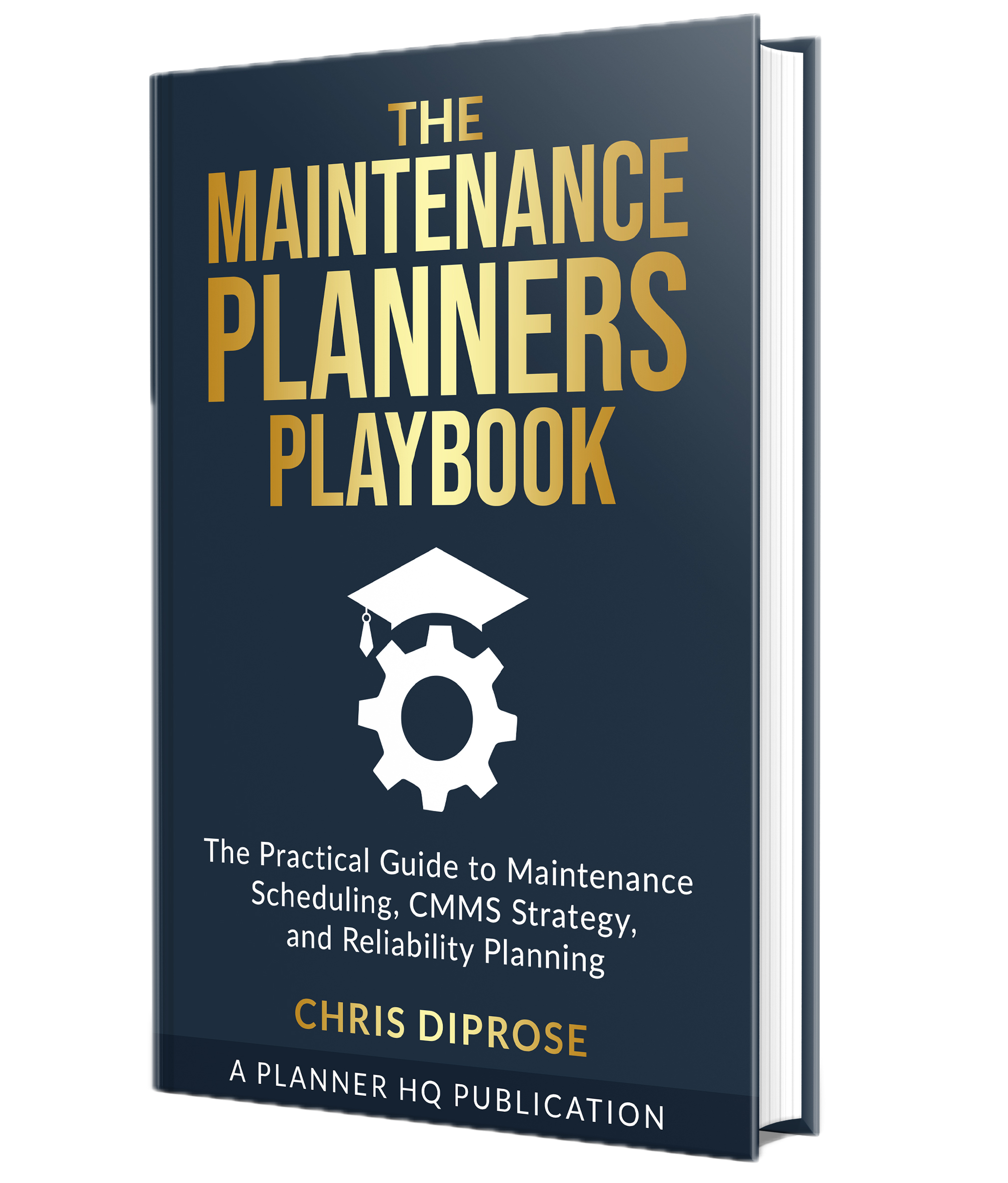
The Maintenance Planners Playbook
A practical guide to building disciplined, effective maintenance planning functions in environments where systems and data matter. The Playbook addresses how planning intent should be translated into consistent behaviours, standards, and structures that can be supported by a CMMS rather than undermined by it.
From a CMMS and data governance perspective, the book explores how unclear roles, weak standards, and inconsistent behaviours lead to poor data quality and unreliable planning outputs. It provides a planning-first view of how systems should be used to reinforce discipline, support decision-making, and scale planning capability over time.
This book addresses:
- How planning functions mature as systems and data discipline improve
- How planning intent should shape system configuration and use
- The behaviours and standards that underpin reliable data
- Why governance and ownership matter more than CMMS features

CMMS Mastery
A deep-dive guide focused on building CMMS environments that genuinely support maintenance planning, reliability, and decision-making at scale. CMMS Mastery is designed to move beyond system features and implementation checklists, focusing instead on configuration intent, data governance, and the behaviours that determine whether a CMMS delivers long-term value.
The book will explore how planners, system owners, and organisations can design and govern CMMS platforms to reinforce discipline, maintain data integrity, and enable consistent planning outcomes across teams and sites.
CMMS & DATA GOVERNANCE // Key Related Articles
What is a CMMS? A Planner’s guide to the essentials
For a maintenance planner, the CMMS is more than a digital filing cabinet. It’s the backbone of the planning system. It’s the system that makes backlog management possible, job plans structured, and scheduling disciplined.
Without it, planning becomes a guessing game.
10 Ways to Improve CMMS Data Quality
Your CMMS is only as good as the data it contains. Even the most advanced maintenance planning system will fall short if the information feeding it is inaccurate, inconsistent, or incomplete.
A Guide to Creating Physical Asset Hierarchy
Have you ever wondered why some companies excel in maintenance while others constantly struggle with inefficiencies? The answer often lies in their foundation. A well-structured asset hierarchy is a fundamental building block that helps build a solid maintenance foundation.
How CMMS and Data Governance Shape Planning Effectiveness
CMMS platforms and the data that sit within them do not merely record maintenance activity. They shape how planning decisions are made, how work flows through the organisation, and how consistently planning discipline is applied at scale. In practice, systems encode behaviour. What they make easy becomes normal. What they make difficult is avoided or worked around.
From a planning perspective, CMMS effectiveness is not defined by feature sets or dashboards, but by whether the system supports clear decision-making before work reaches execution. When data structures, workflows, and standards are aligned with planning intent, the CMMS becomes an enabler of control and foresight. When they are not, it becomes a source of friction, noise, and rework.
Many organisations invest heavily in CMMS technology with the expectation that data quality and planning performance will improve as a result. In reality, systems tend to amplify existing behaviours rather than correct them. Poorly governed environments produce poorly governed data, regardless of the platform in use. Without clear ownership, standards, and accountability, data quality degrades gradually, often unnoticed, until trust in the system is lost.
For planners, this erosion of trust has practical consequences. When asset structures are inconsistent, work order statuses are unreliable, or planning fields are used inconsistently, planners are forced to compensate manually. Decisions that should be made upstream are deferred, and planning effort shifts away from preparation toward validation and correction. Over time, the CMMS is treated as a record-keeping tool rather than a planning system.
Effective CMMS governance starts with clarity of intent. Asset hierarchies, work order workflows, and data standards should be designed around how planning is meant to function, not around vendor defaults or historical practices. This requires deliberate choices about what data matters, who owns it, and how it is maintained. From a planning lens, governance exists to reduce uncertainty, not to enforce compliance for its own sake.
Adoption and behaviour are equally critical. Even well-designed systems fail when usability is poor or when expectations around data entry and quality are unclear. Planners often sit at the intersection of system design and operational reality, relying on consistent input from technicians and supervisors to make informed decisions. Governance models that ignore this human element tend to produce technically correct systems that are operationally fragile.
At an enterprise level, CMMS and data governance determine whether planning can scale. As organisations grow, add sites, or increase asset complexity, informal practices and individual workarounds become unsustainable. Governance provides the structure that allows planning standards to be applied consistently without over-reliance on individual expertise. For planners, this consistency is what enables meaningful analysis, credible reporting, and long-term improvement.
Ultimately, CMMS and data governance define the boundary between planning as a local practice and planning as an organisational capability. When systems are aligned with planning intent and governed with discipline, planners can focus on improving readiness, flow, and decision quality. When they are not, even experienced planners struggle to create value despite significant effort. In this sense, CMMS governance is not a technical concern. It is a foundational enabler of effective maintenance planning.
Stay Connected to the Planner HQ Learning Journey
Occasional updates when new frameworks, resources, and planning insights are released.
Why CMMS & Data Governance Matters
CMMS and data governance determine whether planning decisions are made with confidence or assumption. When systems are poorly structured and data standards are weak, planners spend their time validating information rather than preparing work, and decision-making shifts downstream where it is least effective.
Strong governance creates trust in planning inputs. It ensures that asset data, work order status, and planning information can be relied upon, allowing uncertainty to be addressed before work reaches execution. This trust is essential for schedule credibility, meaningful performance measurement, and effective prioritisation.
At scale, CMMS discipline becomes a strategic necessity. Organisations that rely on informal practices and individual workarounds struggle to sustain planning effectiveness as complexity increases. Robust data governance enables planning to operate consistently across sites, teams, and asset classes, supporting long-term reliability and continuous improvement.
Who This Pillar Is For?
This pillar is particularly relevant for:
1
Maintenance planners working in CMMS-heavy or data-driven environments
2
CMMS administrators and system owners responsible for configuration and control
3
Reliability and asset management leaders relying on data for decision-making
4
Organisations scaling planning across multiple sites or asset portfolios
How This Pillar Connects to the Wider System
CMMS and data governance provide the structural backbone that allows planning intent to be applied consistently. The clarity established in Planning Foundations defines what data matters and why, while this pillar determines how that intent is embedded within systems and sustained over time.
Work Management and Execution rely on CMMS structures that support controlled workflows, clear statuses, and reliable readiness information. When data governance is weak, execution absorbs the resulting uncertainty through delays, rework, and manual intervention. Strong governance enables planning discipline to survive operational pressure.
Asset and spare parts strategies depend on accurate, structured asset data and bills of material. Without reliable system foundations, reliability initiatives and stock strategies struggle to deliver value, regardless of effort or investment.
Performance measurement and improvement are only meaningful when underpinned by trustworthy data. This pillar enables consistent reporting, benchmarking, and trend analysis, allowing organisations to move beyond anecdote and reactiveness toward informed, strategic decision-making.
PILLAR NAVIGATION
Use the below buttons to navigate between the 5 Pillars

PLANNING FOUNDATIONS

WORK MANAGEMENT & EXECUTION

CMMS & DATA GOVERNANCE

ASSET & SPARE PARTS STRATEGY