

The maintenance planner role is one of the most talked about yet least understood positions in modern maintenance organisations.
Ask ten people what a planner does and you’ll likely get ten different answers.
Some will say they “build job plans.”
Others will describe them as schedulers, administrators, or even data analysts.
In reality, the role sits somewhere between all of these; and that’s exactly why the it is so important.
A maintenance planner’s day isn’t defined by a single task. It’s defined by coordination, structure, and decision-making. They sit at the centre of maintenance execution, ensuring work flows smoothly from request to completion, without unnecessary delays, waste, or disruption.
This article walks through what a maintenance planner actually does, using a typical day as the lens, not because every day looks the same, but because the rhythm of the role reveals its true value.
The Planner starts the day before the day begins
A good planner’s work rarely starts when technicians clock in.
Before a shift even begins, the planner is already thinking ahead, reviewing what’s planned, what’s at risk, and what might disrupt the schedule. They check yesterday’s execution, assess which jobs were completed, which slipped, and why. This isn’t about chasing people; it’s about learning.
Did parts arrive late? Was access unavailable? Did a job take longer than expected? Each answer feeds back into how future work is planned.
This constant feedback loop is one of the planner’s most valuable contributions. Without it, maintenance teams repeat the same mistakes week after week, wondering why productivity never improves.
Managing the backlog is a daily responsibility
A large part of the planner’s role revolves around the maintenance backlog. But contrary to popular belief, backlog management isn’t about keeping a long list tidy, it’s about controlling risk, workload, and priorities.
Throughout the day, planners review new work requests, clarify vague scopes, challenge poor problem descriptions, and ensure jobs are correctly prioritised. They decide which work is genuinely urgent and which can be planned properly.
This judgement is critical. Too many organisations confuse responsiveness with urgency. A planner provides balance, protecting the schedule from unnecessary disruption while ensuring real risks are addressed quickly.
A healthy backlog doesn’t mean having less work. It means having the right work, in the right order, at the right level of readiness.
Turning requests into executable work
Perhaps the most misunderstood part of a planner’s job is job planning itself.
Planning is not about filling out fields in a CMMS. It’s about preparing work so technicians can execute efficiently, safely, and without avoidable delays.
During the day, planners develop or refine job plans by defining task sequences, identifying required skills, estimating durations, and confirming parts, tools, permits, and access requirements. They remove ambiguity before it reaches the shop floor.
When done well, this preparation dramatically improves wrench time. Technicians spend more time working and less time waiting, searching, or improvising.
This is where planners add tangible value, not through speed, but through foresight.
The planner is constantly coordinating
A maintenance planner spends a surprising amount of time communicating.
They speak with supervisors about labour availability. They align with operations on access windows. They work with stores to confirm parts. They support reliability engineers with data and feedback. They answer questions from technicians who need clarity before starting work.
This coordination role often goes unnoticed, but it’s essential. Maintenance is cross-functional by nature, and planners are the glue that holds it together.
Without this coordination, even well-planned jobs can fail. With it, maintenance becomes predictable, controlled, and far less reactive.
Data quality is a huge part of the job, whether it’s recognised or not
Every interaction a planner has with the CMMS shapes the quality of maintenance data.
They ensure assets are correctly structured, work orders are meaningful, failure codes make sense, and feedback is captured consistently. They correct errors, challenge poor inputs, and help technicians understand why good data matters.
In a digital maintenance world, this data feeds dashboards, KPIs, predictive models, and long-term asset strategies. If the data is wrong, decisions will be wrong too.
Planners are often the last line of defence between operational reality and misleading metrics.
Supporting the weekly planning and scheduling cycle
As the day progresses, planners are also looking ahead to the next planning cycle.
They assess which jobs will be ready for the upcoming week, confirm material availability, and ensure priorities align with business objectives. They help build schedules that are realistic, not optimistic, balancing workload against available labour.
This is where planning discipline really shows. A planner’s goal isn’t to fill every available hour; it’s to build a schedule that can actually be achieved.
When schedules are consistently met, trust grows between maintenance and operations. When they aren’t, frustration follows. Planners play a key role in maintaining that trust.
The role is becoming increasingly strategic
Modern planners are no longer confined to short-term execution.
As maintenance becomes more data-driven, planners increasingly contribute to asset strategy, reliability improvement, PM optimisation, and CMMS development. They help identify recurring failures, highlight inefficiencies, and support continuous improvement initiatives.
Because planners understand both the system and the shop floor, they’re uniquely positioned to spot gaps between intent and reality. They see where processes break down and where small changes can have a big impact.
This strategic influence doesn’t come from authority. It comes from insight.
No two days are the same
There is often no such thing as a “typical” day for a maintenance planner.
Some days are spent deep in job plans. Others are dominated by coordination and problem-solving. Occasionally, everything goes wrong and the planner becomes the calm centre of a storm of competing demands.
What remains consistent is the planner’s purpose: to bring structure to complexity, clarity to uncertainty, and control to a system that naturally wants to become reactive.
A maintenance planner doesn’t turn spanners, but they shape how effectively those spanners are used.
They don’t manage people, but they influence how people work.
They don’t own assets, but they protect asset performance every day.
Understanding what a maintenance planner actually does means understanding how maintenance succeeds or fails behind the scenes. When planning is strong, maintenance feels smooth. When it’s weak, the cracks quickly show.
As organisations push further into digital maintenance, the planner’s role will only continue to grow in importance.
No matter how advanced the tools become, someone still needs to make the work make sense.
If this snapshot of a maintenance planner’s day feels familiar, it’s because the challenges rarely come from the tools themselves, but from how work is structured around them. Planning sits at the centre of it all, balancing time, information, people, and priorities in an environment that never stands still.
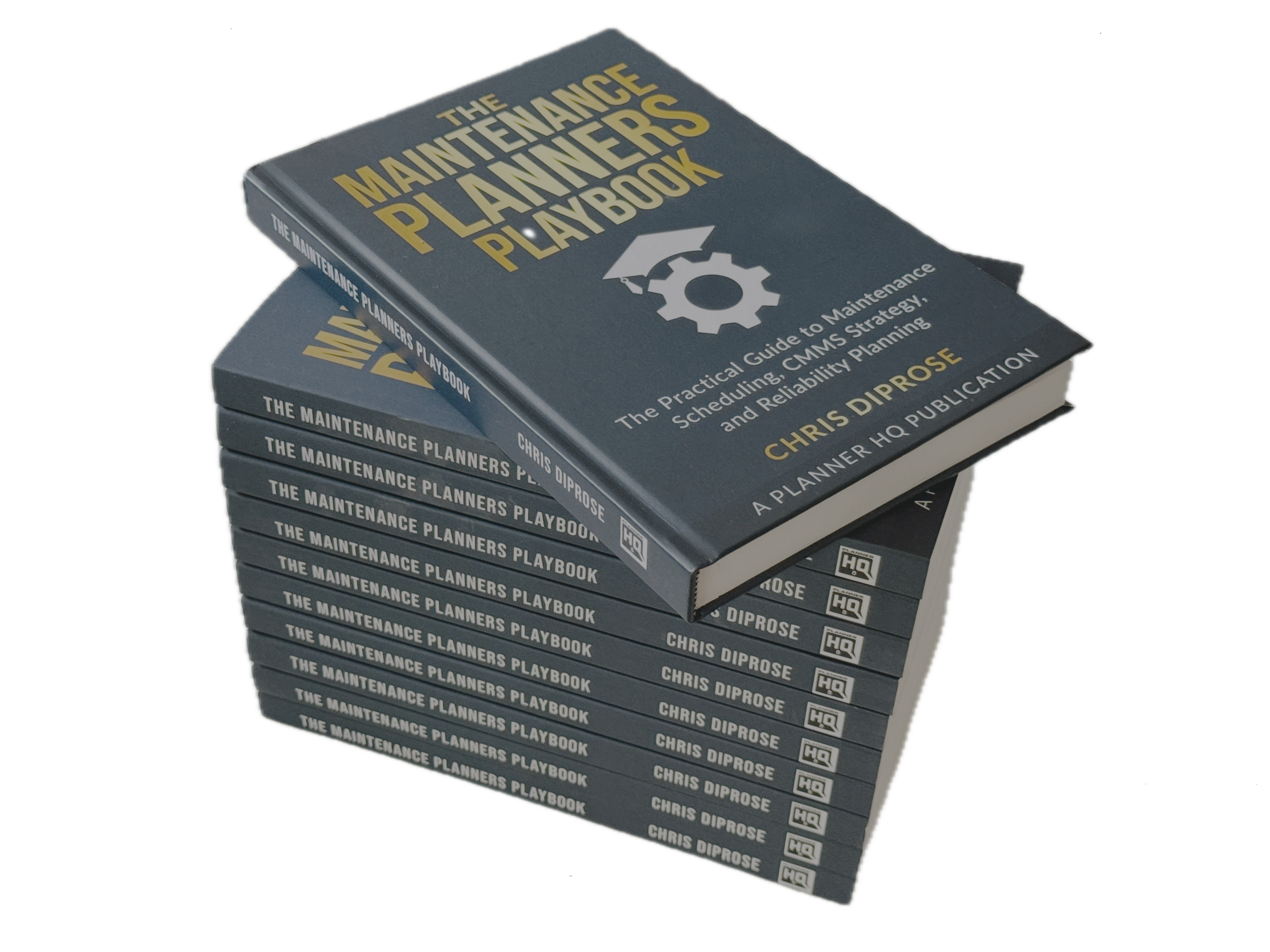
The Maintenance Planner’s Playbook was written to support planners navigating exactly this reality. It goes deeper into the systems, habits, and decision-making behind effective planning, scheduling, CMMS use, and reliability-focused work management. Whether you’re new to the role or looking to sharpen your approach, it’s designed to reflect how planning actually works day to day, not just how it looks on paper.