Maintenance planning is one of the most misunderstood functions in asset management. It rarely has a clear cost centre, it doesn’t directly fix equipment, and it often competes for attention with more visible priorities like production uptime or project work. As a result, many organisations underinvest in it; assuming it’s an administrative layer rather than a strategic capability.
That assumption is expensive.
Poor or absent maintenance planning quietly drains productivity, inflates costs, and undermines reliability. A strong planning function, on the other hand, delivers measurable financial, operational, and cultural returns. Yet many leadership teams have never quantified those benefits in concrete terms.
If you need to justify the value of planning — whether you’re building a business case for a new role, training investment, or a broader process improvement — here’s how to do it.
Why Planning Matters
At its core, maintenance planning is about creating structure and predictability in how work is executed. Planners don’t turn wrenches, but they ensure that when a technician does, everything needed for the job is ready and correct.
That preparation; scoping the task, identifying parts, arranging permits, verifying asset data, might seem like an overhead, but it eliminates hours of waste during execution. Studies across multiple industries consistently show that a well-planned maintenance task takes 30–50% less time than an unplanned one.
That’s because the planner removes friction. When the job starts, there’s no confusion, no missing tools, and no waiting for materials. Multiply that time saving across hundreds of jobs per year, and the return becomes substantial.
Planning isn’t just about efficiency; it’s about reliability. A properly scoped job ensures the right maintenance is done at the right time, reducing repeat failures and protecting asset life.
The Hidden Cost of Not Planning
To build a business case, it helps to quantify what happens when planning is neglected. The signs are easy to recognise:
- Technicians waste time waiting for permits, parts, or instructions.
- Reactive work dominates the week, disrupting preventive tasks.
- Backlogs grow uncontrollably, filled with vague or duplicate work orders.
- Equipment fails unexpectedly, forcing costly overtime and unplanned downtime.
- Data quality decays, making analysis and improvement nearly impossible.
Each of these outcomes carries a cost.
Let’s take a simple example. Suppose your maintenance team spends 10,000 labour hours per year on corrective work. If poor planning wastes even 10% of that time through delays, searching for parts, or miscommunication, that’s 1,000 hours of lost productivity. At £40 per labour hour, that’s £40,000 per year in wasted time — before factoring in the cost of downtime or production loss.
In reality, most organisations lose far more. Unplanned downtime, expedited parts, and overtime premiums can multiply those losses several times over.
When planning is absent, maintenance teams spend their week fighting fires. It feels busy, but it isn’t productive. The business pays for activity rather than results.
The Financial Impact of Effective Planning
A well-structured planning function delivers both direct savings and indirect performance gains. Here are five key areas where the financial benefits become visible:
- 1. Labour Productivity
Planned work typically achieves 40–60% higher wrench time compared to unplanned work. If your technicians spend more time actually maintaining assets and less time waiting or reworking, the same workforce can complete far more work — without hiring additional headcount. - 2. Reduced Downtime
Better job preparation and proactive maintenance scheduling reduce unplanned outages. Every avoided failure protects production hours, reduces quality losses, and prevents expensive emergency callouts. - 3. Inventory and Procurement Savings
Planners forecast demand, standardise parts lists, and coordinate with stores and procurement. This prevents overstocking slow-moving spares and reduces costly expedited purchases when critical items run out. - 4. Improved Maintenance Quality
Clear job plans ensure consistent, standardised execution. That means fewer repeat failures, better equipment reliability, and lower long-term asset replacement costs. - 5. Data Integrity and Decision Support
A planner’s attention to detail ensures accurate feedback and asset history in the CMMS. That data enables reliability teams to make informed decisions — from identifying bad actors to optimising PM frequencies.
Each of these benefits has measurable financial value. Together, they justify planning as a profit enabler rather than a cost centre.
Quantifying the Return
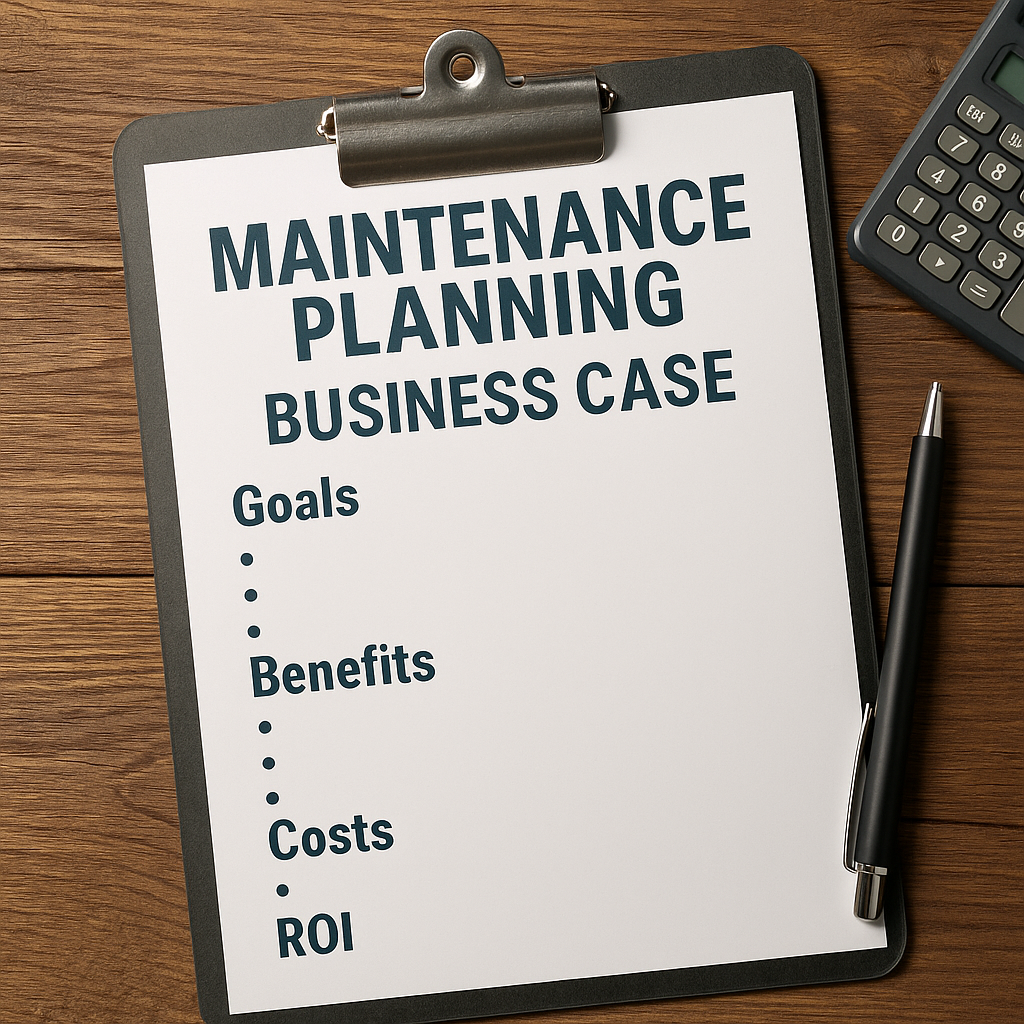
To strengthen your business case, convert planning benefits into simple metrics leadership can understand.
For example:
- Labour efficiency: If planners increase effective wrench time from 30% to 45%, that’s a 50% improvement in productivity. For a 10-person maintenance team, it’s equivalent to adding five full-time technicians without increasing labour cost.
- Downtime reduction: A single avoided breakdown on a critical production line can save tens of thousands in lost output — often more than the annual salary of a planner.
- Procurement savings: Improved forecasting and parts standardisation can easily reduce annual spare parts spend by 5–10%.
- PM compliance: Higher schedule compliance directly reduces reactive work, leading to more predictable maintenance costs and improved safety.
In most cases, a single full-time planner role pays for itself within the first year, often within six months.
The Organisational Impact
Beyond financial returns, investing in maintenance planning transforms how teams work.
Planners bring order and visibility to the maintenance process. They create standard workflows, improve communication between operations and maintenance, and reduce the stress of last-minute firefighting. Over time, this stability builds a culture of trust and accountability.
Operations teams begin to see maintenance as a reliable partner rather than a disruption. Technicians feel supported rather than rushed. Supervisors gain the time to coach rather than constantly react. Reliability engineers receive accurate data to refine asset strategies.
Planning becomes the quiet backbone that enables every other role to perform better.
Building the Case for Leadership
When presenting the business case to leadership, focus on three principles:
- Speak in business terms, not maintenance jargon.
Frame planning benefits around productivity, cost avoidance, and risk reduction. Executives care about uptime, return on assets, and operational efficiency — not backlog size or CMMS fields. - Show cause and effect.
Demonstrate how poor planning directly causes waste: idle time, rework, and emergency costs. Then show how structured planning eliminates that waste. - Position planning as a maturity step, not an overhead.
Emphasise that strong planning is a hallmark of advanced maintenance organisations. It’s not bureaucracy; it’s the infrastructure that enables proactive reliability management.
A compelling business case uses both logic and evidence. Combine industry benchmarks with internal data where possible. Show how your maintenance function could unlock hidden capacity through better planning discipline.
Common Objections and How to Address Them
“We don’t have time to plan; we’re too busy fixing.”
That’s precisely the problem. Without planning, you’ll always be fixing. Planning creates time by preventing chaos.
“We can’t afford another position.”
You’re already paying for it — through inefficiency, overtime, and downtime. A planner role simply redirects that cost into value.
“We’ve tried planning before and it didn’t work.”
Then it wasn’t planning; it was paperwork. Real planning means controlling job readiness, not just filling forms. It requires structure, training, and clear boundaries between planning, scheduling, and supervision.
Maintenance planning isn’t an administrative expense; it’s an operational investment with measurable financial and cultural returns. It creates flow, stability, and control — the foundations of reliability.
When you invest in planning, you’re not just hiring a planner; you’re buying back lost productivity, reducing risk, and strengthening your asset management system.
At Planner HQ, we work with organisations that understand this principle — those ready to build planning functions that deliver real reliability outcomes. Whether you’re defining a new role, training your team, or building a business case, you can find tools and resources to support that journey at theplannerhq.com.